
The invention provides a modular bicycle frame constructed using multiple composite boards that serve as load-bearing members. These boards are joined through a mechanical fastening system using bolts, brackets, and other hardware to form a strong and lightweight structure. The framework includes specific components such as a steering bracket, a rear plate for wheel mounting, and features that allow attachment of bicycle accessories like disc brakes. The design offers adaptability for both conventional and electric bicycles by providing space for battery and motor integration. It is intended to enable environmentally sustainable and low-cost manufacturing using minimal tools and infrastructure.
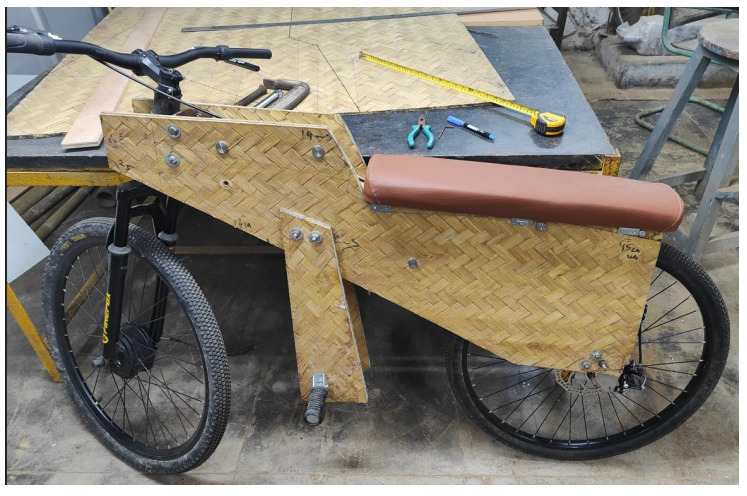
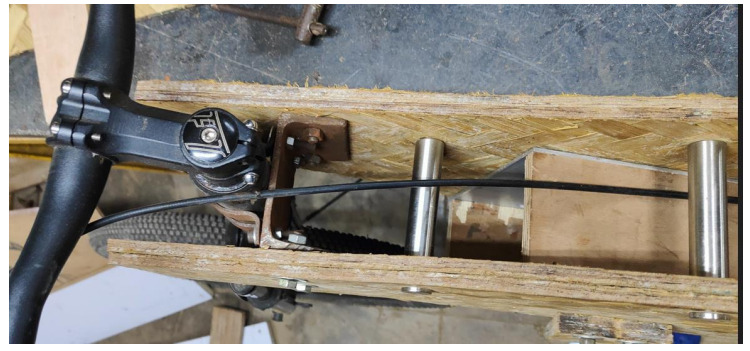
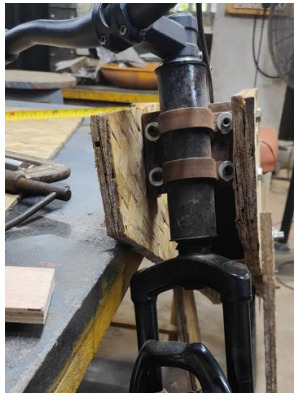
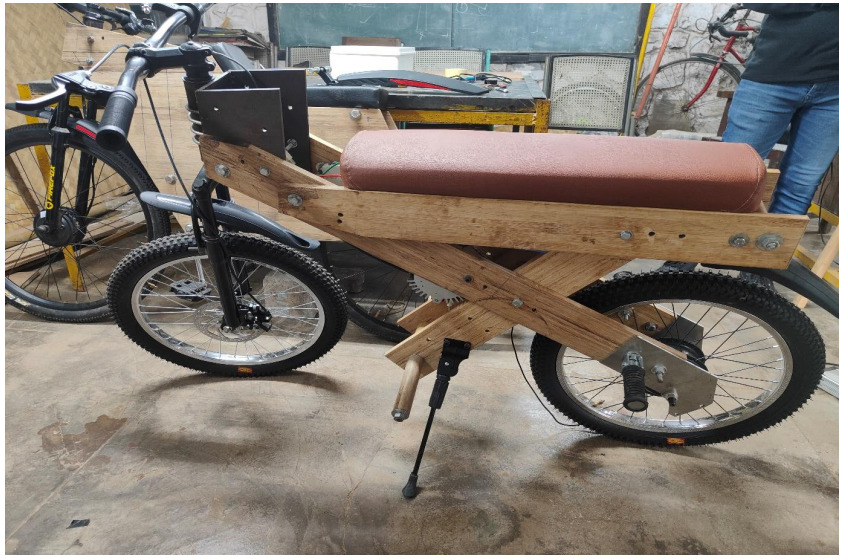
Figure (1) Body Frame; (2) Top view Depicting Steering attachment Using U clamps and U bracket, Mirror studs for attaching adjacent bamboo mat boards, and battery box; (3) Front Fork U-Clamp Attachment; (4) Prototype 2 brake plate attachment design
Conventional bicycle frames are primarily made of metals or carbon fiber, which require industrial-grade tools and welding processes for fabrication and repair. This makes them expensive, environmentally taxing, and inaccessible for decentralized or rural manufacturing. Additionally, current designs do not allow easy integration of components like batteries or motors without structural modifications. There is a need for a low-cost, eco-friendly, modular bicycle frame that can be manufactured, assembled, and repaired without specialized tools while being compatible with electric drive systems.
- Modular Composite Frame Structure: The bicycle frame is built from multiple load-bearing composite boards that are mechanically joined using nuts, bolts, and brackets to create a rigid and lightweight core.
- Material Versatility: The structure utilizes bamboo-based or other sustainable composite materials that reduce overall frame weight and environmental impact while maintaining mechanical strength.
- Battery and Motor Compatibility: The space between the composite boards is intentionally engineered to allow secure placement of battery packs and motor units for electric bicycle applications.
- Ease of Maintenance: The modular assembly allows damaged parts to be individually replaced or repaired using commonly available tools and hardware, reducing repair complexity and downtime.
- Environmentally Sustainable Manufacturing: The frame can be fabricated without the need for industrial machinery, enabling low-carbon, decentralized production and job creation in rural or resource-constrained areas.
Prototypes were constructed using composite boards, including bamboo-based materials, assembled with nuts, bolts, and structured brackets to form a rigid frame. A steering bracket and a rear plate were developed for wheel attachment and disc brake mounting. The rear plate featured multiple slots to accommodate different axle positions. The frame components were joined using L-shaped and U-shaped brackets, mirror studs, and flat joining plates. Provisions were made for integrating battery and motor units between the composite boards for electric bicycle configurations. The prototype confirmed compatibility with standard bicycle parts and demonstrated ease of assembly using basic tools.
The composite board-based bicycle frame has been successfully prototyped using composite materials and standard joining hardware. The prototype includes key components such as the steering bracket, rear mounting plate, and multiple composite boards joined through mechanical fasteners. It has been tested for compatibility with standard bicycle parts, including brakes, wheels, and motor-battery assemblies. The design is validated for both conventional and electric bicycle configurations and is ready for further optimization, pilot production, and field-level deployment.
6
The invention provides an accessible, low-cost bicycle frame that can be fabricated and assembled without industrial tools, enabling local manufacturing and repair in rural or resource-limited areas. By using eco-friendly composite boards and eliminating the need for welding or specialized equipment, the technology promotes sustainable mobility, supports green entrepreneurship, and reduces dependence on conventional metal-based frames. It empowers communities to build and maintain their own transportation solutions, thereby improving mobility, livelihood, and environmental outcomes.
- Rural Mobility Solutions: Enables locally fabricated bicycles in rural areas using basic tools and eco-friendly materials
- Electric Bicycle Manufacturing: Supports integration of battery and motor units within the frame structure for e-bike applications
- Green Transportation Industry: Contributes to low-carbon personal mobility through sustainable frame design
- DIY and Modular Bicycle Kits: Offers a customizable and repairable bicycle platform for consumers and startups
- Decentralized Manufacturing and Assembly: Facilitates community-level production without reliance on industrial infrastructure
Geography of IP
Type of IP
202421038112
565615