
The invention relates to a non-flow zinc-bromine battery featuring a vertical stackable design and optimized electrolyte composition. The system uses ZnBr₂ with tetra-N-ethyl ammonium chloride (TEACl) to improve bromine complexation, enhance cycling stability, and suppress self-discharge. With carbon-based electrodes and an additive-stabilized electrolyte, the battery achieves high energy density and long cycle life, making it suitable for stationary energy storage applications.
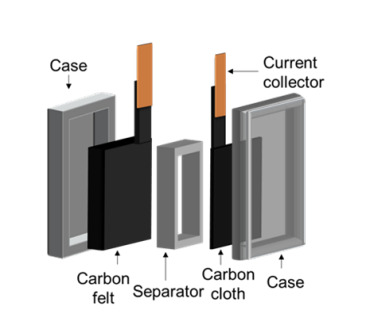
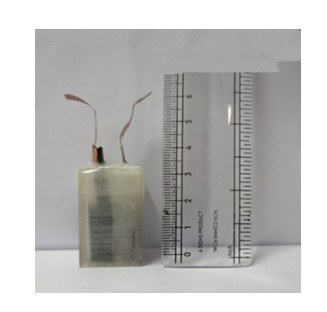
Figure (1) Schematic of the cell; (2) A photograph of the sealed cell as prepared
Conventional zinc-bromine flow batteries suffer from energy inefficiencies due to complex pumping systems and high membrane costs, while existing non-flow systems often face limitations such as poor cycle life, high self-discharge, bromine crossover, and precipitation of inactive salts. There is a need for a compact, non-flow zinc-bromine battery system that delivers high energy density, long cycle life, and stable electrochemical performance without relying on expensive components or flow mechanisms.
- Non-Flow Vertical Stackable Design: The battery employs a vertical, stackable configuration without external flow or pumping systems. This architecture enables modular scalability and compact integration for energy storage systems.
- Optimized Electrolyte Composition: The system uses an aqueous ZnBr₂ solution (0.9 – 1 M) with TEACl (0.7 – 0.75 M) as a bromine-trapping additive. This formulation improves bromine handling, suppresses side reactions, and prevents salt precipitation.
- High Energy Density and Stability: The battery delivers an energy density of approximately 153.9 Wh/kg based on ZnBr₂ content. It demonstrates >1000 stable cycles with high coulombic and energy efficiency throughout operation.
- Carbon-Based Electrodes: The positive electrode comprises pyrolyzed carbon felt, while the negative uses carbon cloth. Thermal treatment enhances electrode wettability and lowers charge-discharge overpotential.
The prototype battery consists of a vertical, non-flow configuration using pyrolyzed carbon felt as the positive electrode and carbon cloth as the negative electrode. The electrolyte comprises 0.9 – 1 M ZnBr₂ and 0.7 – 0.75 M tetra-N-ethyl ammonium chloride (TEACl) in aqueous solution. Electrodes are assembled with titanium or copper foil current collectors, and spacers are placed between electrodes. Electrochemical testing across multiple configurations (3.25–81 mAh) demonstrated stable performance for over 1000 cycles, with high coulombic and energy efficiencies. The system effectively suppresses self-discharge and maintains capacity over repeated use.
The non-flow zinc-bromine battery has been successfully developed and tested at laboratory scale using multiple configurations with varying capacities. Performance has been validated through over 1000 charge-discharge cycles, demonstrating stable capacity retention, high coulombic efficiency (~90%–95%), and consistent energy efficiency (~75%). The system has also been benchmarked against TPABr-based designs, with TEACl-based cells showing improved cycle life and lower internal resistance, confirming the robustness and scalability of the design.
5
This invention offers a safe, cost-effective, and scalable alternative to lithium-ion and flow battery technologies for stationary energy storage. By eliminating the need for flow systems and flammable materials, it enhances operational safety and reduces complexity. Its long cycle life and high energy density support widespread adoption in grid backup, renewable energy storage, and decentralized power systems, contributing to energy sustainability and improved energy access in remote and underserved areas.
- Stationary Energy Storage Systems (ESS): Ideal for long-duration storage with high energy density and long cycle life
- Renewable Energy Integration: Effective for stabilizing intermittent energy from solar and wind sources
- Off-grid and Remote Area Electrification: Suitable for providing reliable backup power in areas without grid connectivity
- Commercial and Industrial Backup Power: Offers a viable alternative to conventional UPS and diesel generators
- Smart Grids and Distributed Energy Systems: Supports load balancing, peak shaving, and grid resilience initiatives
- Battery Manufacturing and Materials Industry: Relevant to manufacturers of carbon-based electrodes, electrolyte additives, and compact cell architectures
Geography of IP
Type of IP
202421039851
560510