
The invention relates to a smart electronic sensor based on a knitted polyester-rubber elastic band coated with graphene oxide, which is chemically reduced to form reduced graphene oxide (RGO). This fabric-based sensor exhibits high sensitivity to strain and is capable of monitoring physiological signals such as pulse, respiration, and motion. It demonstrates a high gauge factor, good repeatability, and functionality under both dry and wet conditions. The sensor is scalable, compatible with textile manufacturing, and suitable for integration into wearable systems for real-time physiological monitoring.
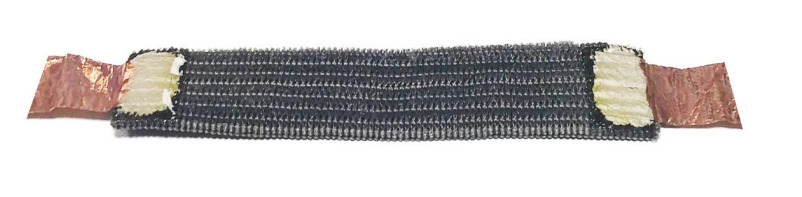
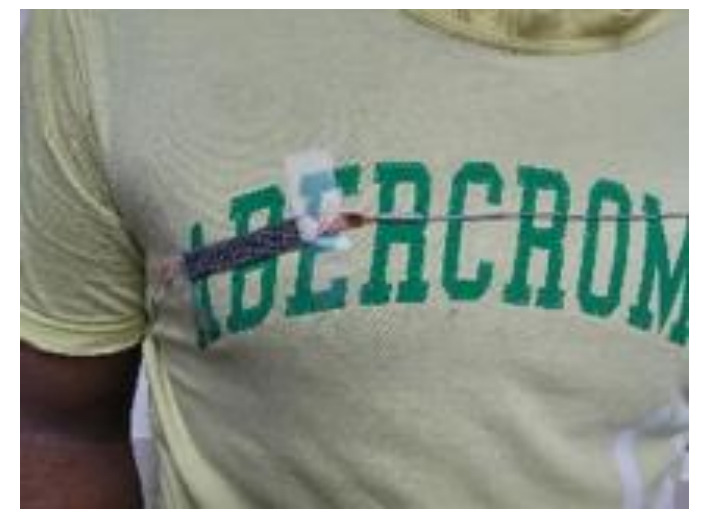
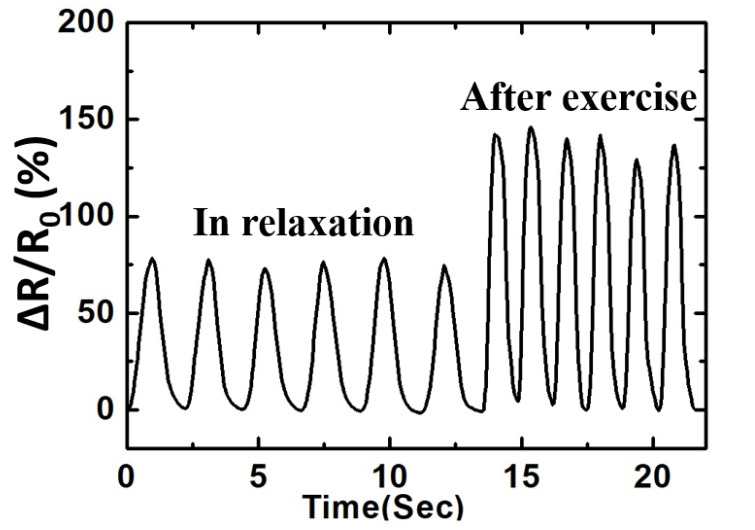
Figure (1) Image of the as fabricated smart electronic fabric sensor - the dimension of smart fabric sensor is 45 mm x 10 mm; (2) Smart electronic fabric sensor mounted onto the chest to monitor the respiration rate of a subject; (3) Illustrates the relative change in resistance-time plot of the smart electronic fabric sensor on the chest during breathing in relaxation and after physical exercise. The breathing could be sensed and recorded by the smart electronic fabric sensor under both normal conditions and after physical exercise. It can be observed that the amplitude and frequency of signal peaks under two conditions were clearly different, which is mainly due to the shallow breathing in relaxation and the frequent and deep breathing after the physical exercise, respectively.
Conventional physiological sensors often suffer from low sensitivity, limited stretchability, and incompatibility with scalable textile manufacturing. They typically require complex fabrication methods and rigid materials, making them unsuitable for wearable, continuous health monitoring. There is a need for a highly sensitive, low-cost, and textile-compatible sensor that can be seamlessly integrated into garments and reliably monitor physiological parameters such as pulse, respiration, and body movements in both dry and wet conditions.
- Graphene-Based Conductive Coating: The sensor uses a knitted elastic band coated with graphene oxide and chemically reduced to RGO. This coating provides enhanced conductivity and reliable strain-dependent electrical response.
- Flexible and Scalable Textile Integration: The sensor is fabricated on a polyester-rubber band compatible with industrial knitting techniques. It enables seamless integration into wearable garments or as standalone bands.
- High Sensitivity and Stability: The device shows a gauge factor of ~34 at low strain and ~5 at higher strain ranges. It outperforms conventional metal-based strain gauges in both sensitivity and recovery.
- Multi-Parameter Physiological Monitoring: The sensor detects radial artery pulse, respiratory activity, and joint motion with high precision. It remains functional and stable in both dry and immersed (wet) environments.
The prototype consists of a knitted elastic band made from 80% polyester yarn wrapped around a 20% rubber core. The band is soaked in an aqueous graphene oxide (GO) solution, then chemically reduced using hydrazine hydrate to form reduced graphene oxide (RGO) on the fabric surface. After drying, the RGO-coated band is connected with copper wires using silver paste to form a wearable strain sensor. The prototype has been tested for monitoring radial pulse, respiratory rate, and joint motion, and exhibits stable resistance change, high gauge factor, and consistent signal performance across various conditions including dry and water-immersed environments.
The smart fabric sensor has been successfully developed and validated at laboratory scale. It has been tested for real-time monitoring of radial artery pulse, respiratory rate, and joint motion under both dry and wet conditions. The sensor demonstrates consistent resistance response under cyclic loading and strain, with stable gauge factor values and excellent signal reproducibility. Performance has been confirmed through experimental trials involving wearable application on the wrist, chest, and fingers, showing reliable physiological signal tracking.
4
The invention provides a cost-effective, non-invasive, and wearable solution for continuous physiological monitoring, addressing the growing need for real-time health data in medical diagnostics, rehabilitation, and fitness. Its compatibility with textile-based manufacturing enables large-scale integration into garments, making it highly suitable for remote healthcare, elderly care, and daily wellness tracking. By offering accurate monitoring of vital signs such as pulse, respiration, and body movement, the technology promotes preventive healthcare and enhances quality of life.
- Wearable Physiological Monitoring Systems: Enables real-time tracking of pulse, respiration, and motion through wearable fabric-based sensors
- Health and Medical Diagnostics: Provides accurate physiological signal detection for non-invasive health assessments
- Rehabilitation and Elderly Care: Monitors joint motion and breathing to assist in recovery and elderly mobility evaluation
- Sports and Fitness Tracking Devices: Tracks respiratory rate and movement during physical activity for performance monitoring
- Smart Textiles and Garment-Integrated Sensors: Integrates seamlessly into clothing using knitted elastic bands coated with graphene-based material
- Remote and Continuous Patient Monitoring Systems: Allows long-duration, remote monitoring of vital signs under varying environmental conditions
- Consumer Healthcare and Wellness Electronics: Supports personal health tracking in wearable consumer devices using cost-effective sensors
Geography of IP
Type of IP
201821019280
370588