
The invention presents a Geogrid Reinforced Soil Wall (GRSW) structure integrated with a capillary Barrier system (CBS) that enhances the performance of GRSWs using low-permeable backfills. The CBS comprises a top layer of low-permeable fine-grained soil over a bottom layer of coarse sand. This configuration diverts rainwater laterally, minimizing downward infiltration and preventing excess pore water pressure build-up. It ensures better retention of suction, structural stability, and enables the use of native, poorly draining soils. This makes the GRSW structure cost-effective, eco friendly, and sustainable.

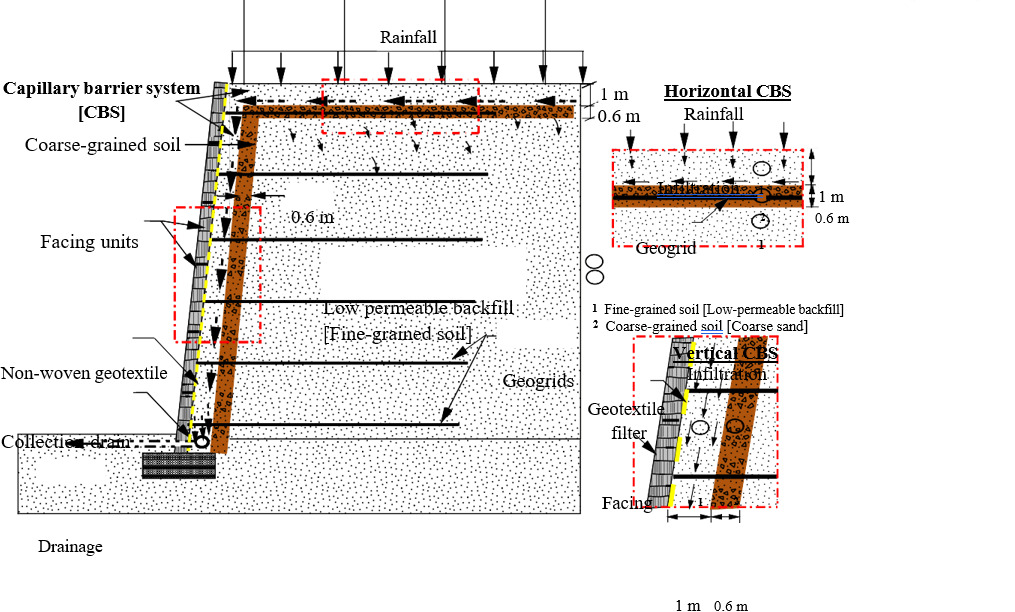

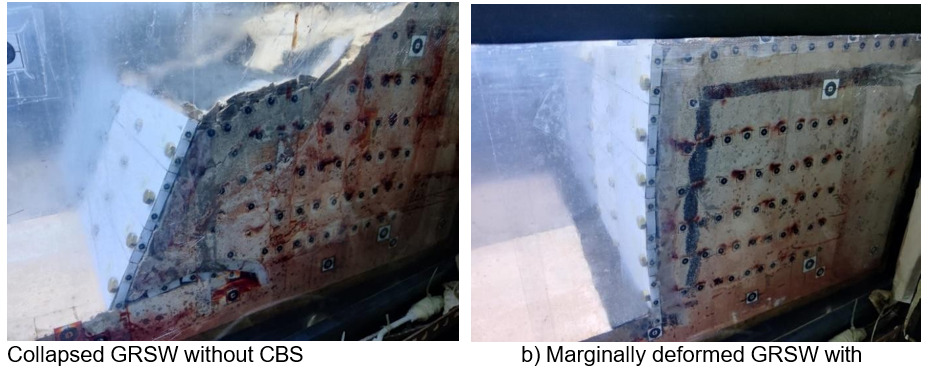
Figure (1) Concept representation of Mechanism of CBS in minimizing the infiltration of rainwater into the slope; (2) Schematic representation of working principle of CBS in a GRSW; (3) View of front elevation of GRSWs at 40 gravities (equivalent to 10 m GRSW): (3a) 10 m high geogrid reinforced soil wall (without CBS at time of failure), (3b) 10 m geogrid reinforced soil wall (with CBS at the end of testing); (4) Perspective view of GRSWs with and without CBS after subjecting to sustained rainfall at the end of test
Traditional Geogrid Reinforced Soil Walls (GRSWs) are prone to failure when constructed with low-permeable native soils due to rainfall infiltration. This leads to excess pore water pressure, reduced shear strength, and wall deformation. There is a need for a sustainable, cost-effective solution that allows the use of such soils without compromising structural integrity.
- Innovative Capillary Barrier System (CBS): It incorporates a two-layer cover—top fine-grained soil and bottom coarse-grained material—on the GRSW to block rainfall infiltration.
- Capillary Action-Based Water Control: The hydraulic contrast between layers induces lateral diversion of water, preventing it from entering the reinforced soil zone.
- Retention of Suction: It minimizes pore pressure buildup and preserves the strength of the backfill during rainfall.
- Compatible with Low-Permeable Soils: It enables the use of local, poorly draining soils like silty sand (with 20% fines), cutting down on the need for expensive granular fill.
- No External Drainage Needed: It eliminates the need for chimney drains or gravel layers, simplifying design and reducing costs.
- High Structural Stability: It reduces geogrid strain by 85%, crest settlement by 95%, and face movement by 96% compared to conventional GRSWs.
- Cost-Efficient & Eco-Friendly: It utilizes in-situ materials, reduces carbon footprint, and supports sustainable construction.
Centrifuge model tests were conducted using a 4.5 m radius large beam facility available at the Indian Institute of Technology Bombay, India. The models consisted of GRSWs with six geogrid layers, tested under 40g gravitational force with simulated rainfall of 10 mm/h. One model had CBS, the other did not. The prototype with CBS showed significant performance improvement over 30 days of rainfall exposure.
This technology has been validated through centrifuge model studies simulating high-intensity rainfall. GRSWs with CBS showed no distress even after 30 days of antecedent rainfall, unlike conventional walls which failed within 13 days. Pore water pressures were reduced by 75%, while geogrid strains dropped by 85%.
9
This innovation ensures safer infrastructure in areas with poor backfill soil availability, especially under changing climate patterns with erratic rainfall. It enables cost-effective and eco-friendly wall construction, reduces maintenance needs, and improves the resilience of highway and railway embankments, benefiting rural and urban communities alike.
- Transportation Infrastructure: Highway and railway embankments
- Urban Retaining Structures
- Landslide-prone or High-Rainfall Zones
- Geotechnical and Civil Engineering Projects
- Government and Private Construction Agencies
Geography of IP
Type of IP
202321007418
475438