
This invention discloses a method and system for precoding in wideband MIMO OFDM systems using a matrix lattice all-pass filter in the time-domain. The system computes filter coefficients based on channel responses at specific subcarriers and adjusts these coefficients adaptively to minimize feedback information. The proposed method eliminates the need for data vector conversions between time and frequency domains, offering enhanced efficiency and better subcarrier interpolation compared to existing techniques.
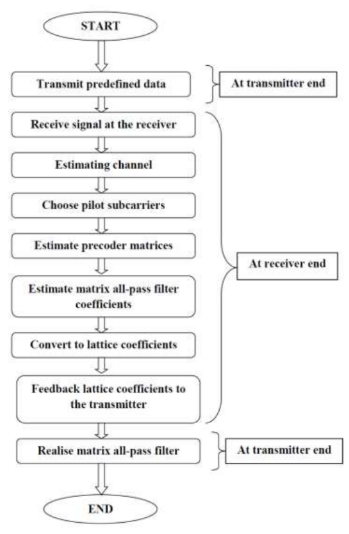
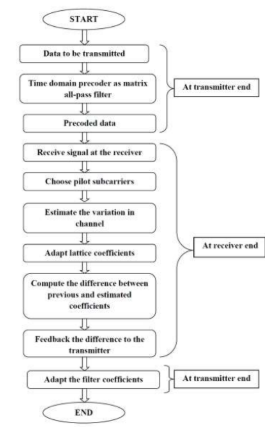
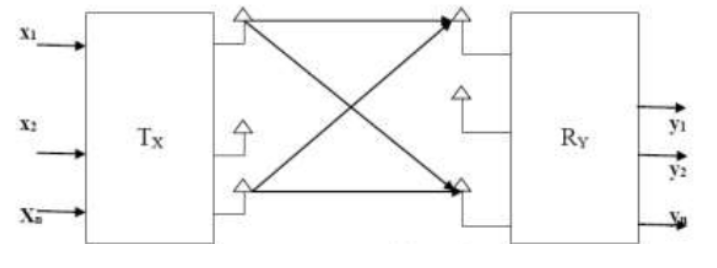
Figure (1) Schematic flowchart of step 1 of a method of precoding in an MIMO OFDM system; (2) Schematic flowchart of step 2 of a method of precoding in an MIMO OFDM system; (3) Schematic MIMO OFDM system for precoding
The challenge in wideband MIMO OFDM (Multiple-Input Multiple-Output Orthogonal Frequency-Division Multiplexing) systems is achieving optimal signal transmission and performance with minimal feedback information. Traditional frequency-domain precoding methods involve frequent conversions between the time and frequency domains, which are resource-intensive. The current invention addresses this by proposing a novel method and system that perform precoding in the time-domain using a matrix lattice all-pass filter, designed to optimize signal transmission without the need for time-frequency conversions, thereby reducing feedback requirements and enhancing overall performance.
- Time-Domain Precoding: The invention uses a time-domain implementation of a matrix lattice all-pass filter to perform signal precoding reducing computational overhead and improving system efficiency.
- Adaptive Quantization: This ensures that feedback information is minimized, leading to reduced system complexity and enhanced performance.
- Improved Subcarrier Interpolation: The proposed method offers better subcarrier interpolation compared to existing Geodesic interpolation and Givens rotation techniques, ensuring more accurate signal processing and transmission.
The prototype consists of a MIMO OFDM system with a transmitter and receiver subsystems. The transmitter employs a matrix lattice all-pass filter for time-domain precoding, while the receiver performs the adaptive quantization of filter coefficients. The system captures the channel responses at specific subcarriers and estimates the filter coefficients using matrix unimodular interpolation. Subsequently, the coefficients are transmitted back to the transmitter for real-time adjustments, enhancing overall system efficiency and performance.
Basic formulation confirmation; stage of realistic representation of end use
4
This technology enhances the efficiency and performance of wideband MIMO OFDM systems, making them more suitable for next-generation wireless communication technologies, such as 6G, by reducing the burden on the feedback links and improving data rate and spectral efficiency. The innovation supports the development of advanced wireless communication systems, contributing to advancements in 5G and 6G networks, thereby enabling higher throughput and better reliability in various applications.
- MIMO Wireless Communication Systems: Optimizes data transmission and reception in MIMO wireless systems
- Wideband MIMO OFDM Systems: Enhanced performance and reliability in wideband OFDM systems
- Mobile Networks: Supports higher data rates and better reliability in mobile communication systems
- Internet of Things (IoT): Enables efficient and high-throughput IoT applications
- Cloud Computing: Improves data processing and transmission in cloud computing environments
Geography of IP
Type of IP
202421010925
560849