
This invention offers a high-capacity, very-lightweight compression system, with multi-media support, optimized for low-power edge devices like drones and surveillance cameras. It eliminates the need for complex onboard processors by using simple hardware and a deep learning decoder for fast, secure reconstruction. Onboard compression reduces data size and transmission latency, while inherently encrypting data for enhanced security. Ideal for peace-time surveillance, personal monitoring, and drone applications, the system extends battery life and lowers costs. This patented solution addresses the growing demand for secure, compact, and efficient media processing on edge devices.
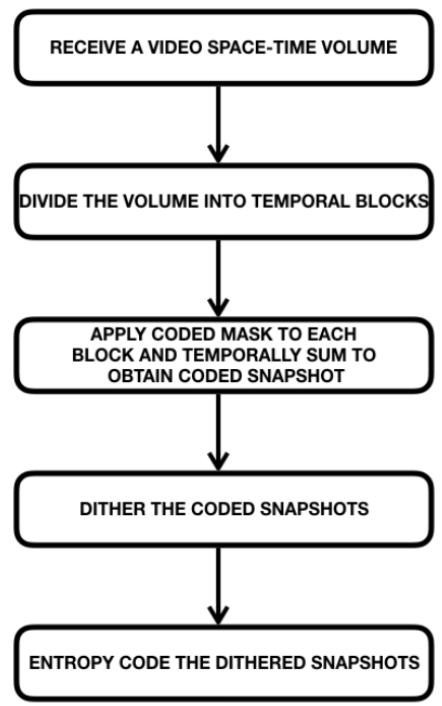
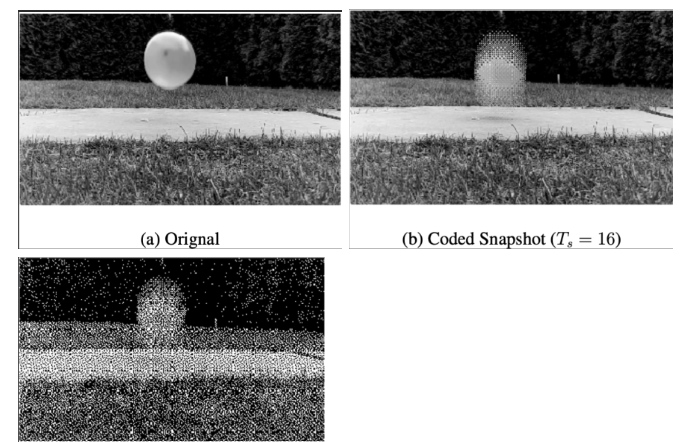
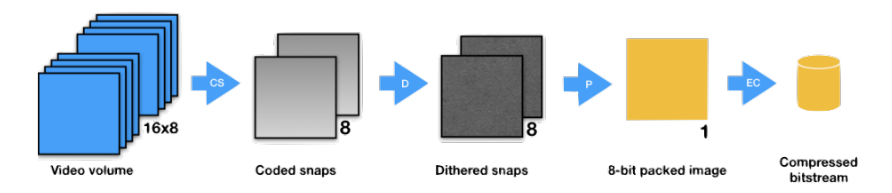
Figure (1) Represents the block-wise flow of the method, showing stages of masking, adding, dithering, and compression; (2A) A frame of the original video, (2B) Coded snaps of 16 frames, (2C) Dithered part of the coded snaps; (3) A diagram showing the components of the proposed extremely low complexity acquisition-cum-compression pipeline.
Traditional media compression techniques often rely on complex computations making them unsuitable for very-low-power or resource-constrained devices like drones, mobile sensors, or edge devices. These methods typically require powerful onboard processors, consume significant power, and increase latency in data transmission. There is a need for a lightweight, high-capacity compression method that minimizes computational burden, reduces spatial-requirement and transmission latency without compromising reconstruction quality.
- Lightweight Computation: The compression engine requires only simple hardware components such as comparators, eliminating the need for complex onboard processors.
- AI-Based Reconstruction: It incorporates a deep neural network-based decoder for real-time, non-iterative reconstruction.
- Multi-Modal Media Support: This process is capable of compressing and reconstructing various types of images, video files and hyperspectral (HS) data.
- Reduced Latency: By compressing data on-device, transmission latency is substantially decreased, enabling faster communication.
- Energy-Efficient Design: This process is well-suited for low-power edge devices or onboard systems, enhancing energy efficiency and reducing latency.
- Minimal Hardware Footprint: It requires minimal onboard memory and in-place computational space, making it ideal for compact devices.
- Enhanced Data Security: Since compression occurs onboard, the data is inherently encrypted due to the choice of a random mask; unauthorized access (e.g., by intercepting drones) is prevented without the dedicated neural network decoder.
The prototype consists of a device equipped with a user interface, processor, and memory. The media file is divided into blocks of predefined thickness. A compression engine performs a masking technique over each block to obtain masked frames, which are then added to form single coded snapshots which are then dithered followed by optional entropy encoding. During reconstruction, the compressed bitstream is reshaped and passed through a learnt neural network, which recovers the images/video or spectral blocks from the dithered snapshots. The decompressed blocks are then stitched to form the final decompressed media file.
Integration with operational hardware and software systems; all functionality testing and finalization for end use; user manual/training/bug fixing.
8
This technology enhances the capability of low-power and resource-constrained devices to perform real-time media compression and decompression, optimizing energy efficiency and performance in consumer electronics, mobile devices, and edge computing systems. This enables efficient data transmission and storage, thereby reducing energy consumption and improving computational performance in large-scale data processing tasks. Additionally, it facilitates deployment in remote or resource-constrained environments, enhancing situational awareness and contributing to public safety, environmental monitoring, and defense applications.
- Edge computing in autonomous vehicles, UAVs, and field-deployed sensors
- Hyperspectral or optical imaging in precision agriculture, satellite imaging, and environmental monitoring
- Peace-time surveillance operations
- Personal surveillance and security systems
Geography of IP
Type of IP
201921041463
553425