
This invention introduces a novel cloud-based, Software Defined Networking (SDN) architecture for delivering content efficiently over wireless networks. The architecture divides the wireless network into multiple layers of interconnected cloud elements, each comprising separate data plane and control plane components. By localizing data storage and computation at the edge (Radio Access Network) and decoupling the data and control functions, the system enhances user experience with faster content access, reduced latency, and optimized network resource usage. It enables intelligent selection of content delivery paths and supports seamless user mobility across different radio access technologies such as LTE, Wi-Fi, and 5G.
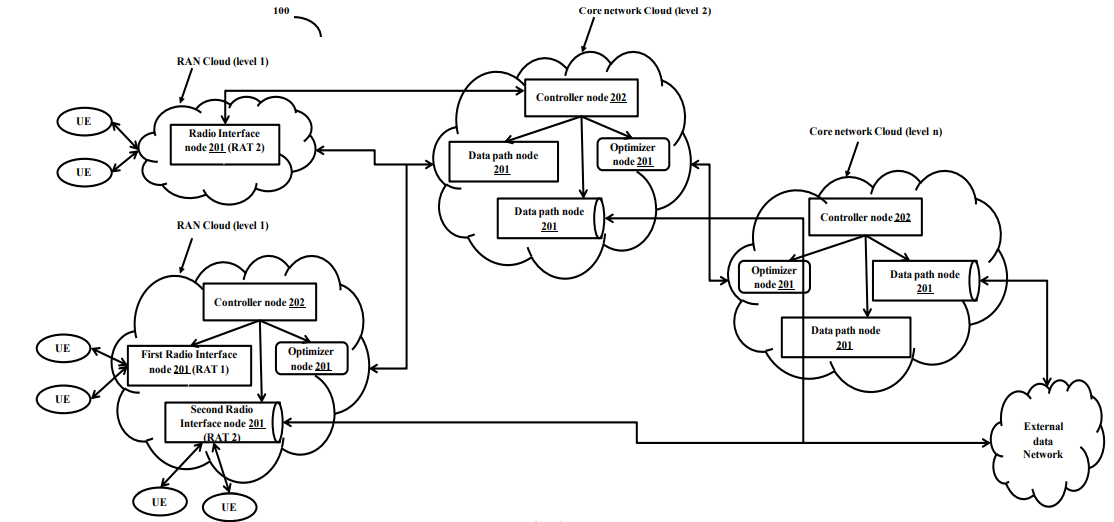
Figure 1. Example data flows
In multi-source power systems, identifying which source is powering a given load is difficult and typically relies on expensive, tamperable sensors. Current techniques lack reliability and scalability. A more secure, low-cost, and accurate method is needed to determine the active power source and analyze load behavior without depending on invasive hardware.
Traditional wireless communication architectures operate as monolithic systems with centralized control, leading to inefficient content delivery, delayed user response times, and poor utilization of available network resources. Additionally, the lack of proximity between users and network storage/computation units increases content access latency. As wireless networks evolve to support rich media and user mobility, there is an urgent need for a modular, distributed, and intelligent content delivery architecture that brings cloud capabilities closer to the user and enhances scalability, performance, and manageability.
A conceptual prototype was designed with simulated RAN and core cloud elements. Control and data plane separation was implemented using SDN principles, and optimizer nodes were configured for local content caching and delivery. The system demonstrated reduced latency, efficient mobility support, and load-aware routing in network simulation scenarios. It validates the feasibility of deploying the architecture in a real-world wireless content delivery network.
The patent includes a complete specification, a detailed claim set, and supporting figures.
2
This invention can revolutionize digital access by making wireless networks faster, more scalable, and smarter—particularly benefiting users in urban, educational, and rural environments. By enabling local content caching and efficient resource use, it reduces infrastructure costs while delivering high-speed access to learning, health, and civic content. The architecture promotes digital inclusion, energy-efficient operations, and lays the groundwork for next-generation mobile ecosystems aligned with smart city and 5G goals.
- Telecommunications networks to enable fast, local content delivery and bandwidth optimization
- Smart campuses and universities to provide seamless access to e-learning resources
- Smart cities and urban infrastructure for real-time multimedia content access
- Edge computing and 5G deployments to enhance mobile video and IoT services
- Public Wi-Fi zones, stadiums, and malls where content demand is high and local caching improves performance
- Defense and emergency response networks for rapid, decentralized data access
- Commercial deployment by telecom companies, CDN providers, and cloud service platforms looking to offer edge services
Geography of IP
Type of IP
201921022025
488215