
Described herein is a system and method for replicating flow within turbid media through vibrating phantoms. The system comprises a solid phantom designed to mimic the optical properties of turbid media, a vibrating platform connected to the phantom, and a signal generator configured to activate the vibrating platform based on statistical methods. This activation simulates a voltage signal with a predetermined statistical pattern selected from various statistical tools, that includes, stochastic differential equations, resulting in the vibrating platform producing vibrations in the phantoms tailored to match the chosen statistical pattern, thereby simulating flow within turbid media.
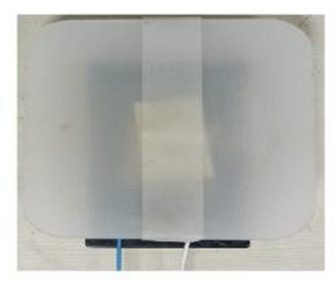
Figure 1. Photograph of the Phantom
Current phantoms replicate static optical properties but cannot simulate dynamic flow like blood movement in turbid media. Liquid phantoms mimic flow but suffer from short shelf life, instability, and limited anatomical accuracy, while solid phantoms lack the ability to emulate physiological motion. Existing methods often require altering the phantom material or fail to capture the statistical nature of real flows. Thus, there is a need for a system that uses solid phantoms and statistical signal-driven vibration to realistically simulate dynamic flow in turbid media.
- Statistical Signal-Based Flow Simulation: The system uniquely uses stochastic differential equations (SDE) and other statistical tools to generate vibration signals that replicate the exact statistical properties (exponential PDFs and autocorrelation) of flow dynamics in turbid media.
- Solid Phantom with Tunable Optical Properties: Unlike traditional liquid phantoms, this system employs solid PDMS-based phantoms that mimic the optical characteristics of biological tissues, offering enhanced stability, longevity, and ease of handling.
- Versatile Vibrating Platform: The use of a piezoelectric (or other types of) vibrating platform allows precise mechanical excitation of the phantom, with vibrations accurately controlled via the generated stochastic signals to simulate flow.
- Mimics Both Surface and Deep Tissue Flow: The system can simulate superficial flows (measured by Laser Speckle Contrast Imaging) and deep tissue flows (measured by Diffuse Correlation Spectroscopy) using the same setup, validated by strong agreement with experimental and analytical models.
- Fast and Real-Time Tunability: Flow conditions can be adjusted instantly and precisely by modifying the parameters of the statistical signals, allowing rapid and flexible simulation of a wide range of flow velocities.
- Experimental Validation with Human Data: The system’s outputs closely replicate real human blood flow measurements, confirming its accuracy and potential for biomedical imaging research and device calibration.
- Convenience and Robustness: Solid phantoms reduce issues associated with liquid phantoms (spillage, evaporation, stability), making the system more practical for repeated and long-term use.
- Broad Application Potential: This technology is applicable to a variety of optical flow measurement techniques and can serve as a standard phantom for calibration, development, and testing of new diagnostic imaging modalities.
The prototype consists of a solid PDMS phantom with optical properties mimicking turbid media, mounted on a piezoelectric transducer that vibrates the phantom based on signals generated by a processing unit using stochastic differential equations (SDE). These SDE-based signals are converted into voltage inputs via a data acquisition system and amplifier to control vibration frequency and amplitude, simulating realistic flow patterns. The system employs a 785 nm laser source and detectors such as avalanche photodiodes to capture scattered light for both surface and deep flow measurements using laser speckle contrast imaging (LSCI) and diffuse correlation spectroscopy (DCS). Validated against theoretical models and human blood flow data, this versatile prototype enables real-time, tunable, and accurate mimicry of flow in turbid media for biomedical imaging applications.
The technology has been tested in lab environments. It provides a tunable solid phantom for laser speckle imaging using an SDE-based signal generation method. A piezo-actuated diffuser enables controlled simulation of blood flow dynamics with high correlation to in-vivo data. The system supports both surface and deep tissue flow modeling, with scalability based on hardware specifications.
5
This technology improves healthcare by enabling accurate simulation of blood flow in tissue phantoms, enhancing the calibration of medical imaging devices. It supports better diagnostics, reduces reliance on animal testing, and accelerates biomedical research, ultimately leading to improved patient care and medical innovation.
- Medical device manufacturing
- Healthcare diagnostics
- Academic and clinical research institutions
- Imaging system developers (optical, MRI, ultrasound, etc.)
- Biotechnology and pharmaceutical companies
Geography of IP
Type of IP
202421015994
560235