
IIT Bombay research shows that heatwaves over the Indo-Gangetic Plains are primarily driven by local land and atmospheric factors, rather than by hot air travelling from elsewhere.
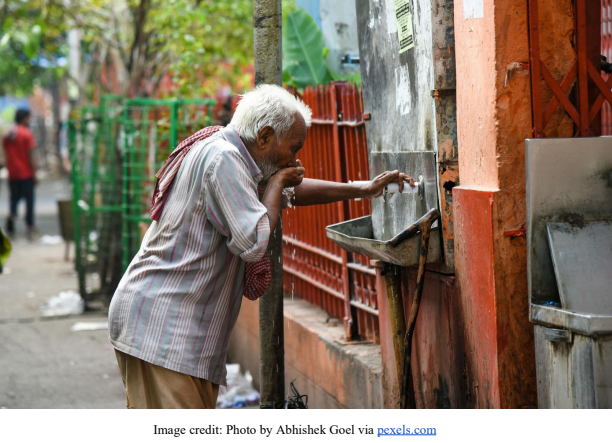
The intensifying heatwaves across Indo-Gangetic Plains (IGP), home to at least 60 crore people, represent a crisis that extends far beyond unbearable temperatures. These extreme heatwave events are not merely a seasonal inconvenience but a direct threat to survival, becoming the new normal, arriving earlier, and lasting longer each passing summer. The health hazards and deaths that are caused by heatwaves each year are extremely concerning.
What causes this annual hazard that threatens lives and livelihoods? For a long time, a widely believed theory was that hot air travels from elsewhere. Now, new research from the Centre of Studies in Resources Engineering and the Centre for Climate Studies at the Indian Institute of Technology Bombay (IIT Bombay) shows that not all IGP heatwaves are the same, and the factors driving their origin are more local than distant.
“Traditionally, forecasting efforts often emphasise whether hot air from north-western regions is being transported across the Indo-Gangetic Plains. Our results suggest that monitoring local land and atmospheric conditions becomes more important for predicting when and where heatwaves will develop within the region. This could help shift forecasts from broad regional warnings to more location-specific early warnings,” explains the study’s lead author Manali Saha, a PhD scholar at IIT Bombay.
Before we delve deeper into these local factors, the researchers note that the formation of an anticyclone, or a large-scale high-pressure system, remains a necessary background condition for heatwaves to develop. So, what are they?
Anticyclones set the stage for heatwaves
Anticyclones are large-scale high-pressure systems in the atmosphere, often spanning hundreds of kilometres. They form due to broader circulation patterns and are influenced by distant factors such as ocean temperatures and planetary-scale circulations. Researchers previously thought that these large-scale systems transported warm air into the Indo-Gangetic Plains. But the new study explains that anticyclones do play a role, but very differently from what was previously thought.
The high-pressure anticyclonic systems lead to warm air sinking toward the surface, suppressing cloud formation. The resulting clear skies and strong incoming solar radiation create favourable conditions for heatwaves. Over the IGP, anticyclones are consistently present during pre-monsoon heat events, setting the broad environment for heat build-up, the study explains. However, the findings show that while anticyclones are necessary, they are not sufficient on their own. It is how local land and atmospheric conditions respond within that high-pressure system that determines if there will be a heatwave.
The new research analysed 10 major pre-monsoon heatwave episodes since 2010 using a heat-budget approach and ERA5 atmospheric reanalysis data, which is a detailed global record of past weather from 1940 to present. The method separates the temperature change into contributions from warm air from other places, air warming as it sinks, and surface-driven heating. By comparing heatwave zones with nearby non-heatwave areas under similar large-scale conditions, the researchers showed that local land–atmosphere differences are central. Two local processes, surface heating and air compression, predominantly influence the formation of heatwaves. Other local factors, humidity and soil moisture, determine the nature of the heatwave.
Moist and dry heatwaves
The study demonstrates that even under the same large-scale anticyclones, two very different types of heatwaves can form. The researchers classify them as moist and dry heatwaves. The study goes a step further by showing that moist heatwaves are linked to a particular sequence of local conditions: pre-monsoon showers add extra moisture days before, the moist soil and increased evaporation lead to cloud formations, low night-time clouds trap heat, and as an anticyclone forms, the land starts feeding more heat into the air. On the other hand, dry heatwaves form in areas with dry soils and clear skies.
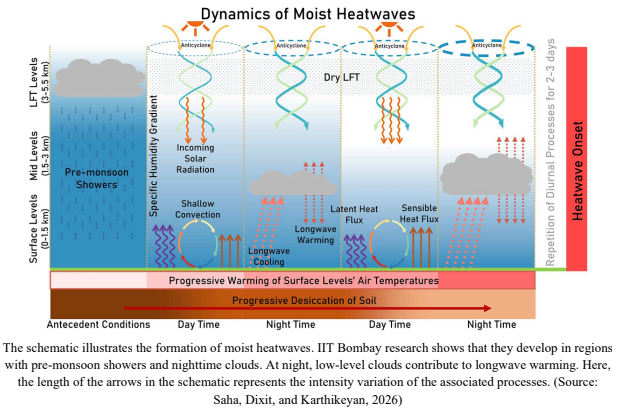
Unlike dry heatwaves, where surface heating dominates, moist heatwaves involve a more complex balance between surface heat, moisture, and cloud processes. As a result, they may not always stand out based on temperature alone, and predicting them may require advanced local-level humidity observations at different altitudes.“
Both types of heatwaves can be deadly. Humid heatwaves are generally more dangerous for the human body because cooling through sweating is ineffective. But dry heatwaves often lead to higher mortality because they tend to last longer and affect larger regions. At present, the India Meteorological Department (IMD) defines heatwaves based primarily on temperature, and does not explicitly distinguish between moist and dry heatwaves. However, our study shows that drivers of moist and dry heatwaves are quite different and recognising this d+-istinction could help improve early warning systems,” says Saha, explaining the importance of this distinction.
Towards better early warning systems
If the problem is local, much of the solution lies there too. The paper identifies a set of local precursors that can foretell the onset and type of a heatwave, such as how the land heats up, how the patterns of premonsoon rainfall are, how humid it is near the surface, how dry the air is, and whether clouds are forming at night. More detailed monitoring of these signals across locations, altitudes, and time could allow forecasters to enhance early warnings and location-specific alerts.“
Once a large-scale anticyclonic system sets up over the region, forecasters can begin closely monitoring these local precursors. Locations where these signals start to deviate from the normal could be more likely to experience heatwave conditions in the following days,” says Prof. Karthikeyan Lanka, Associate Professor at IIT Bombay.
However, most operational early warning systems and heat action plans in India are currently based on surface temperature thresholds alone. The research team plans to develop its own heatwave early warning system and a forecasting decision-support tool, building on the findings of this study.
Prof. Vishal Dixit, a climate scientist at IIT Bombay who is part of the research team, says that the team aims to “use the identified precursors to build a machine-learning–based decision support system that can assist operational agencies in improving heatwave early warning and location-specific forecasts across India.”
According to the researchers, very few studies have examined the physical mechanisms of heatwaves over the Indo-Gangetic Plains, but understanding them is increasingly important as heatwaves become more frequent and intense under climate change. The IIT Bombay study offers the observational ingredients needed for timely and reliable forecasts and warning systems, though it may take time to translate the insights into operational reality.
Prof. Lanka Karthikeyan, Centre of Studies in Resources Engineering and Centre for Climate Studies, Indian Institute of Technology Bombay, Mumbai, India.