
Researchers have identified how common testing errors lead to unreliable data, providing a new blueprint for building the ultra-safe infrastructure needed for a hydrogen-powered world.
The threat of climate change and intensifying geopolitical tensions has compelled nations to quickly transition toward cleaner energy sources. A promising strategy has been to blend hydrogen into our existing natural gas networks. This can reduce our natural gas usage and significantly lower carbon emissions without immediately building thousands of miles of new infrastructure. India has already started down this path, with NTPC Ltd commissioning India’s first green hydrogen blending project in 2023. Started in the NTPC Kawas township in Surat, with a piped natural gas (PNG) network, the project has since scaled up significantly.
Hydrogen, however, is notoriously difficult to contain and transport. Being the smallest atom in the universe, it is able to seep into any solid material used to contain it, including the steel walls of existing pipelines. For hydrogen-blending to scale successfully, researchers must develop precise testing methods to determine exactly how much hydrogen different steel pipes can handle before they risk cracking or leaking. Many of our current methods of testing this often provide inaccurate results, and scientists had no answers to explain the inaccuracies, until now.
In a new study, researchers at the Indian Institute of Technology Bombay and the Max Planck Institute for Sustainable Materials, Germany have identified why our current methods for testing hydrogen-diffusion into metals often fail. Researchers Sudha Gautam, Michael Rohwerder, and Dandapani Vijayshankar investigated a phenomenon known as hydrogen embrittlement, in which hydrogen atoms seep into high-strength steel, rendering it brittle. Their study shows that the tests used to understand embrittlement mechanisms themselves create artificial errors and artefacts that lead engineers to the wrong conclusions.
The researchers focused on the electrochemical permeation technique. In this setup, the sample to be tested is sandwiched between two electrochemical cells. On one side, hydrogen is generated by an electrochemical process and charged into the sample, allowing the hydrogen atoms to diffuse to the other side. On the other end, a detector measures how much of that hydrogen successfully permeates through the sample. Although this is the established method, this test produced results that didn't match the mathematical predictions.
“The H-permeation flux (amount of hydrogen diffusing through the metal) on the detection side typically should not change with time at steady-state conditions. The observation that we made showed a decrease in this flux, whose origin we wanted to identify,” explains Prof. Vijayshankar.
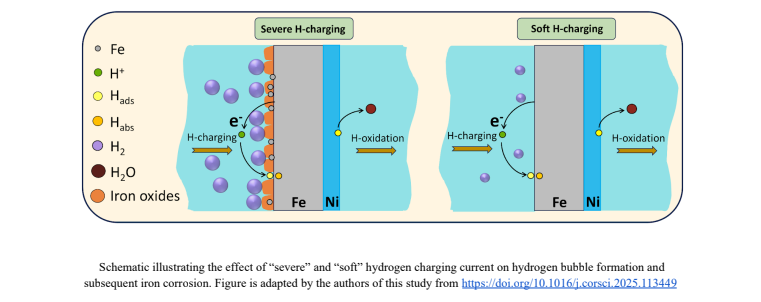
When the team used a high hydrogen charging current, they observed using scanning electron microscopy and Raman spectroscopy, that the steel surface corroded, forming a thin layer of rust. This rust acted as a gatekeeper, affecting the measured hydrogen flux by the detector. Using electron back-scattered diffraction, the team discovered that the higher current generated tiny defects called dislocations, which are irregularities in the steel’s crystal structure, trapping hydrogen.
“We could find iron corrosion products and newly generated dislocations on the hydrogen charging side. It appears that severe electrochemical hydrogen charging increases the density of GND (geometrically necessary dislocations). Our current understanding is limited to correlating it with blister formation, but how these actually form still needs further study,” remarks Sudha Gautam.
The team also found that higher currents led to the formation of hydrogen bubbles on the steel's surface, further skewing the measurements. According to Prof. Vijayshankar, “Hydrogen bubbles form by recombination of a part of atomic hydrogen generated on the steel surface during electrochemical charging. Too severe hydrogen bubble activity was found to cause so-called Ohmic drops in the electrolyte and thus to faulty electrochemical control of the surface. This, along with the high pH at the iron surface, could result in iron corrosion, which affects the hydrogen flux on the detection side.
”Interestingly, the team found that the solution to both these limitations lay in reducing the electric current used to generate the hydrogen to a “soft” charging condition. “Instead of using milliamps, we used microamps of current. This means fewer hydrogen atoms are generated. Although this means that fewer hydrogen atoms diffuse through the sample, it does not matter because we are interested in measuring only how many of the generated ones are passing through,” says Prof. Vijayshankar.
Moreover, the team found that applying a nickel coating to the detection side of the sample further eliminated the interaction of hydrogen atoms with iron oxides on the steel surface. Oxides can prevent the hydrogen atoms from reaching the detector, reducing the measured flux. Their study shows that a coating of nickel (Ni) could mitigate this. While a palladium coating is considered the gold standard, the team found that a much more economical nickel coating could also serve the purpose.
“Nickel also traps hydrogen, similar to the oxides, but the effect can be accounted for in our calculations. Using Pd would be ideal, but without it, a nickel coating is still preferable to having no coating at all,” remarks Prof. Vijayshankar.
By showing that softer charging conditions and nickel coatings produce much more accurate data, this study provides a new standard for laboratory testing of hydrogen flux. It also provides engineers with a reliable way to choose the right materials for hydrogen pipelines. This ensures that if we eventually switch to hydrogen fuel for our homes and cars, the pipes carrying that energy are built to a standard that prevents unexpected leaks or breaks.
Prof. Dandapani Vijayshankar, Indian Institute of Technology Bombay