
Researchers at IIT Bombay reveal how excessive mucus creates gaps in our lungs’ defences, leaving us vulnerable to allergic attacks.
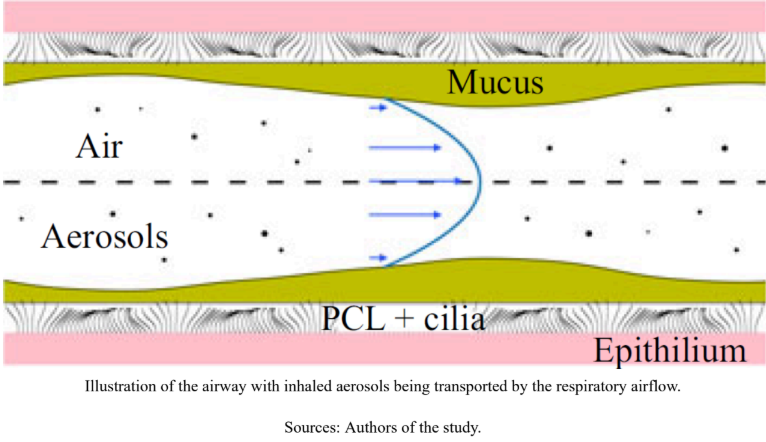
The airways of our lungs have a naturally engineered defence mechanism that gets activated when any foreign material, even microscopic, enters the airways by secreting a fluid called mucus to trap it. But, for millions of people living in cities like Delhi, Mumbai, Bengaluru and other metros, the rising levels of air pollution have been posing a persistent health hazard, despite our in-built defences. The heavy smog-filled air is causing severe respiratory issues for everyone, children, and adults alike.
Now, a recent study from the Indian Institute of Technology Bombay (IIT Bombay) has found that as mucus volume increases in response to pollution (or a foreign material) in the airways, its defence does not improve. Instead, the increased mucus volume ends up creating narrow ‘humps’ that leave large patches of the airway walls completely exposed. This patchy landscape could explain why excessive mucus is detrimental, potentially allowing fine soot particles to penetrate deep into our systems and triggering asthma attacks.
The study conducted by Swarnaditya Hazra and Professor Jason R. Picardo has been published in the Journal of Fluid Mechanics and focuses on the middle airways. These are the branching pipes of the lung that lie midway between the windpipe and the terminal air sacs. The air flow, which is swirling and chaotic in the windpipe, calms as it enters the small middle airways. In this specific region, the physics of the mucus layer is governed by a phenomenon known as the Rayleigh–Plateau instability, which is the same mechanism that causes a thin stream of water to break into droplets. It is driven by surface tension, which pulls the mucus into ring-like collars or ‘humps’ along the tube.
One of the most striking findings of the research is that adding more mucus to the system actually worsens the protection.
“A significant fraction of soot particles has submicron sizes; such tiny particles would deposit on the airway wall by diffusion if the wall is left exposed. Our work shows that the mucus coating, which lines the airways, becomes more patchy as its volume increases,” explains Professor Picardo.
While it might seem logical that more fluid would lead to greater coverage, the researchers found that it was not so.
“To be clear, our finding is that a more voluminous mucus film gathers into humps that are deeper but narrower; consequently, the mucus-depleted zones expand. This is indeed counterintuitive,” adds Professor Picardo.
He explains that the team had actually anticipated this result theoretically before even running their computer simulations. Using a combination of stability and equilibrium theory, they predicted that surface tension would draw the film into these concentrated humps. “It was gratifying to find our expectations borne out”, he adds.
For residents of high-pollution zones, this finding is more than a mathematical curiosity; it is a matter of respiratory survival. Soot particles, common in urban environments, are often submicron in size or thousands of times thinner than a human hair. These tiny particles move through a process called diffusion, and they are highly likely to land on any exposed part of the airway wall. When mucus becomes patchy due to its high volume, it leaves the lung walls vulnerable.
“Beyond the lack of coverage, excessive mucus can also lead to the physical plugging of the airways, obstructing the very air we need to survive,” notes Swarnaditya, citing one of their other works.
This research also sheds light on the ‘vicious cycle’ of rapid-onset asthma. When a person with asthma inhales an allergen, their body reacts by secreting more mucus. According to the IIT Bombay study, this hypersecretion causes the mucus to gather into those narrow humps, exposing more of the airway wall to the very allergens that caused the reaction in the first place.
Professor Picardo suggests this could amplify the allergic response: “Allergen deposition triggers mucus oversecretion and airway constriction... this in turn would result in more of the wall becoming exposed to allergens, whose subsequent deposition would amplify the allergic response.”
While further work is needed to link fluid mechanics to cellular responses, the study provides a physical basis for why some asthma attacks escalate so rapidly.
The study also tracked how particles of different sizes navigate this bumpy internal landscape. Large particles, which have more inertia, are unable to follow the air as it curves around a mucus hump. They crash into the front of the hump and get trapped, a process called inertial impaction. Small particles, meanwhile, are tossed around by air molecules and tend to land in the bare valleys. However, there is a ‘Goldilocks’ zone of intermediate-sized particles that are neither heavy enough to crash nor light enough to drift. These particles can navigate past the humps and escape the lung’s defences entirely.
This discovery has massive implications for the pharmaceutical industry. Currently, most research into inhaled drugs focuses on the very beginning of the respiratory tract (the nose) or the very end (the air sacs). The ‘middle airways’ have long been a mystery. By understanding how these mucus humps form and where they catch particles, scientists can begin to design ‘designer drug particles’ that land exactly where they are needed. Professor Picardo notes that the grand objective is to build a comprehensive model of the entire lung network.
“Our work contributes to this by providing insight into aerosol deposition in the mucus-bearing middle airways, which had not been studied before,” Prof Picardo says.
The researchers also looked at the ‘ciliary elevator’, the tiny, hair-like structures that beat to move mucus out of the lungs. They found that while these hairs are crucial for cleaning the lungs over several minutes, they are far too slow to influence where a particle lands during the split second of an inhale. The air travels hundreds of times faster than the mucus moves, meaning the humpy geometry of the mucus is essentially a fixed obstacle course for every breath we take.
This research highlights the beauty and complexity of the physics within our own bodies. By using mathematical models “with imagination and reasoning”, as Picardo puts it, the team has mapped a hidden world that dictates how we interact with our environment. Clearly, there is more than what we know about how these systems work. In any case, whether it is a life-saving medication or a speck of soot, the journey of every inhaled particle is decided by the rolling hills and barren valleys within our airways, which is an interesting finding.
Prof. Jason R. Picardo, Department of Chemical Engineering, Indian Institute of Technology Bombay, Mumbai 400076, India