
The invention presents a method for identifying potential failure locations in sheet metal components. The method involves determining regions of failures by using the Strain Non-Uniformity Index (SNI) across multiple critical planes within the metal sheet.
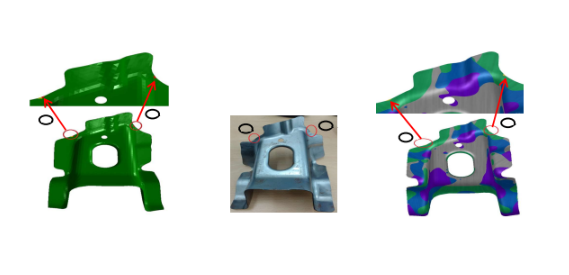
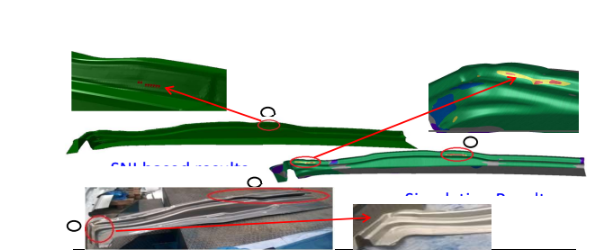
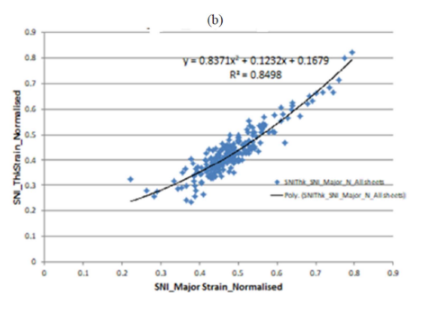
Traditionally, Forming Limit Diagrams (FLDs) and Curves (FLCs) have been used to predict failure in metal sheets, but these methods are often unreliable due to their sensitivity to strain paths and forming conditions. This results in either false positives or false negatives in failure predictions.
- Identification of critical planes: This innovation can be used for identification of critical planes in the sheet metal component, comprising points of peak and minimum major strain.
- Strain Non-Uniformity Index (SNI): SNI can be calculated for major and thickness strains in each critical plane. Comparison of SNI values against threshold values can be made to identify regions of potential failure.
- Accuracy: It utilizes strain distribution over the entire component rather than peak strain values alone, reducing false predictions. It has the capability to predict punch travel at which failure is imminent.
- Cost-effective: It eliminates the need for laboratory samples; actual components can be directly used for failure prediction.
- Flexibility: It accounts for user-defined failure criteria and varying strain paths, unlike traditional FLDs.
- Corrective actions: Provides actionable data to adjust manufacturing processes to prevent failures.
Experimental validation has been carried out using flat blanks marked with circles, which deform into ellipses during testing. The strains were measured, and the SNI was calculated to identify critical planes and potential failure points.
The method has been tested using Nakazima samples from various grades of steel and aluminum alloys, proving the relationship between major strain SNI and thickness strain SNI for failure prediction.
7
This technology helps reduce material waste and production costs by improving the accuracy of failure predictions in metal forming processes. This efficiency can lead to more sustainable manufacturing practices and lower costs for consumers.
- Automotive manufacturing
- Aerospace component production
- Electronic tool manufacturing
Geography of IP
Type of IP
201821003820
409254