
This invention relates to a method for stabilizing expansive soils using Reinforced Fly Ash Columns (RFACs). Each column consists of a compacted fly ash body, a perforated bottom anchor, and a perforated cap anchor, connected by one or more high-strength geocompatible ties (such as geostrips). These columns extend through the active swelling zone of the soil. The system efficiently controls the non-linear swell-shrink behavior of expansive soils while improving subgrade strength and drainage, thereby enabling sustainable and durable infrastructure over problematic soil beds.
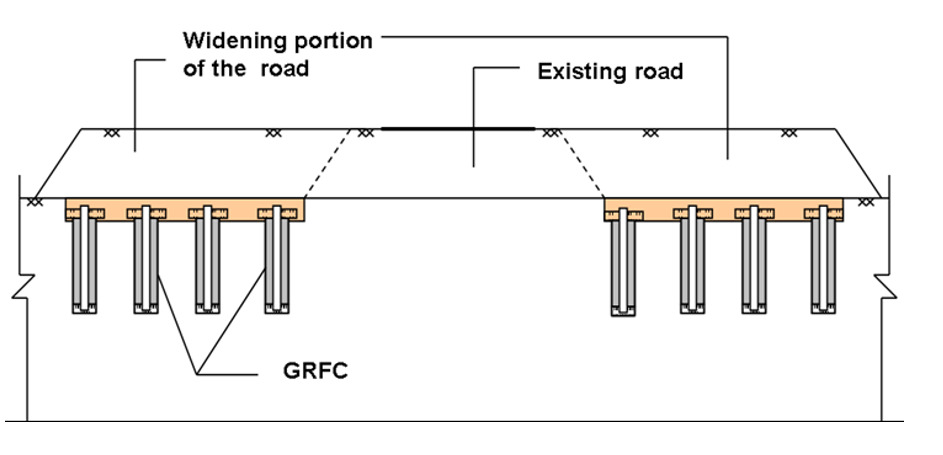
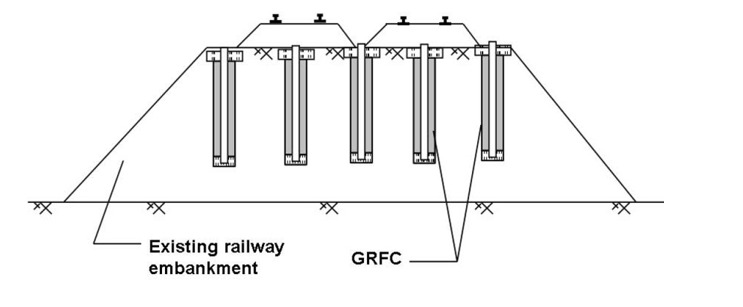
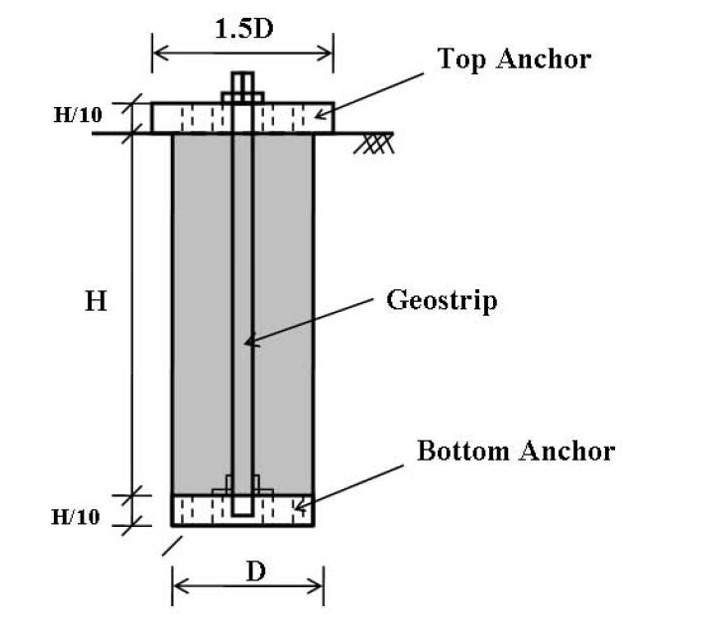
Figure (1) Typical application of widening of roads on expansive soil deposits (in square or triangular pattern); (2) Stabilization of existing railway embankment constructed with expansive soil; (3) Schematic view of Geostrip reinforced fly ash column (D = Diameter of fly ash column; H = Length of fly ash column).
Expansive soils undergo large volume changes due to seasonal moisture variations, leading to swelling and shrinkage. This causes ground heaving, cracks in structures, pavement failures, and slope instability. Conventional methods such as lime stabilization, granular pile anchors, and geopiles or geo columns often fail to provide long-term stability due to limitations in strength, chemical reactivity, and installation challenges. There is a critical need for a reliable, cost-effective, and sustainable method to stabilize expansive soils, particularly in infrastructure applications.
- Reinforced Fly Ash Columns (RFACs): It uses cylindrical fly ash bodies compacted in bores extending through the active swell-shrink zone.
- Anchored Design: Each column is held in place between a perforated concrete bottom anchor and a cap anchor.
- High-Tensile Reinforcing Tie: A flexible geocompatible tie (e.g., geostrips) runs through the column and is tautly fixed between the anchors.
- Material Innovation: Fly ash (industrial by-product) is blended with lime (up to 5%) to enhance soil-structure interaction.
- Drainage-Enabled Design: The perforations in anchors allow water flow to catalyze physico-chemical stabilization.
- Flexible Tie Benefits: It provides strain compatibility and reinforces interaction with fly ash.
- Environmentally Friendly: It utilizes waste fly ash for soil stabilization, reducing environmental impact and material costs.
Lab-scale model with 9 reinforced fly ash columns showed a reduction in swell pressure from 200 kPa to 38 kPa and swelling from 6.56% to 2.36%. Soil strength increased from 40 kPa to 95 kPa. Prototypes used 30 mm diameter columns in a triangular layout.
Laboratory experiments confirm that RFACs reduce swell pressure by up to 4.27 times and increase unconfined compressive strength by over 2 times. Triangular column layouts provide uniform restraint. The technology has been proven through scaled prototypes and validated against critical geotechnical performance metrics.
9
This technology transforms low-value fly ash waste into a high-performance stabilization method for expansive soils. It promotes sustainable infrastructure development, prevents damage to buildings, roads, railway embankments, canal linings and reduces construction and maintenance costs in problematic soil regions. Its application also aids fly ash waste management, aligning with environmental goals in systematic bulk consumption.
- Road and railway subgrade stabilization
- Foundations for buildings in clayey/expansive soils
- Geotechnical engineering and infrastructure development
- Mining and ash disposal reclamation projects
- Waste-to-resource innovations in construction
Geography of IP
Type of IP
201621031243
389610