
This invention introduces a robust and resilient LTE-based wireless network architecture that ensures high availability for mission-critical applications. It uses a set of portable or stationary base stations (BS), each integrating LTE eNodeB and Evolved Packet Core (EPC) modules. Among these, one BS operates as the active node while the rest remain in backup mode, ready to take over in case of failure. This setup supports uninterrupted communication by enabling automatic role switching between base stations using predefined configurations or real-time instructions from an Application Server (AS), thus reducing downtime and enhancing reliability.
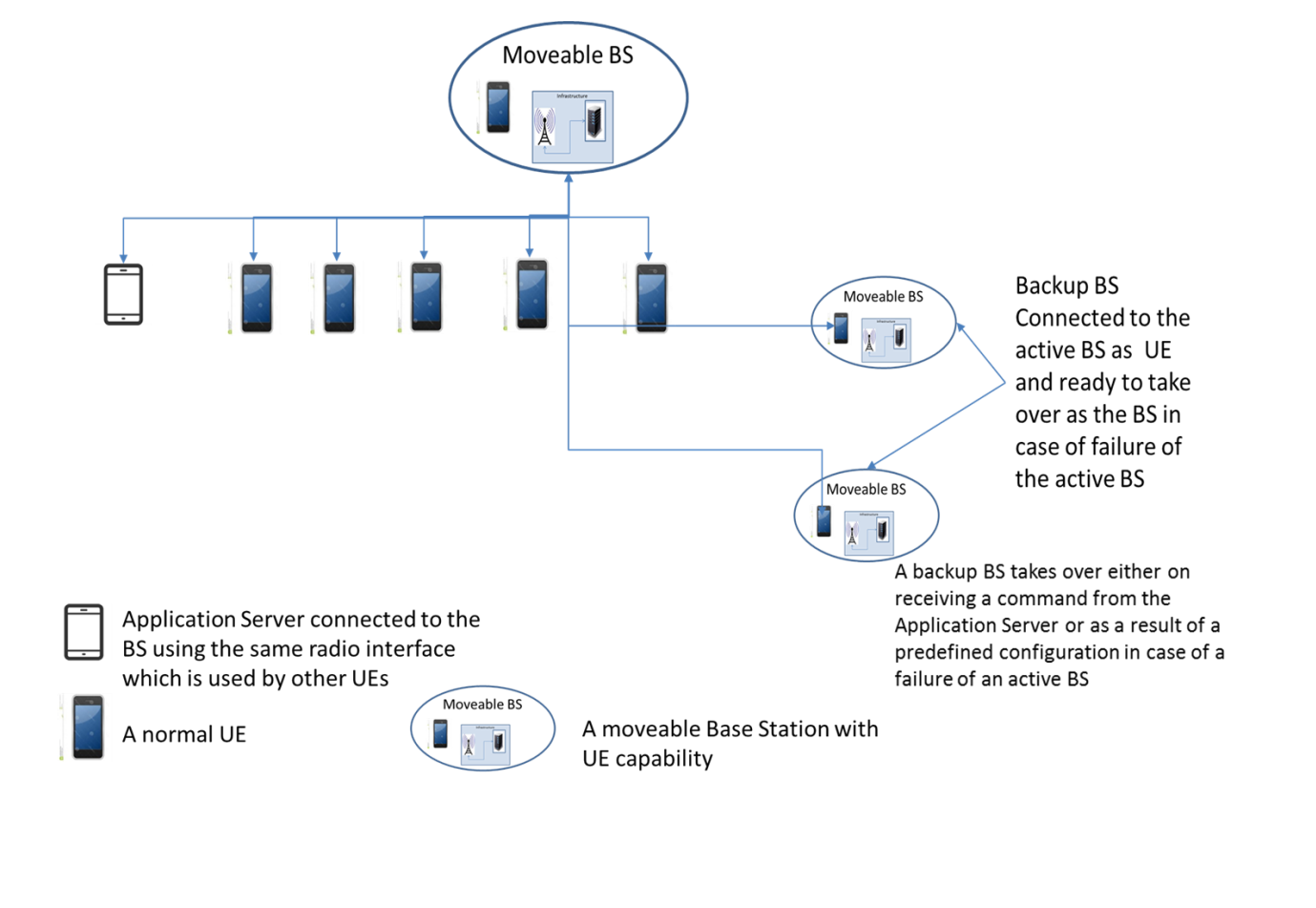
Figure 1. Concept illustration
Traditional LTE network setups depend heavily on a single base station to manage user connectivity and data routing. In remote or disaster-prone areas, a failure in this base station can lead to complete communication loss, which is unacceptable for public safety or emergency applications. Furthermore, establishing wired links and large EPC infrastructure is not feasible in rapidly deployable scenarios. There is a critical need for a lightweight, autonomous, and redundant LTE network solution that continues to function despite hardware failures or infrastructure limitations.
- Integrated Base Station Design: Each base station merges LTE eNodeB and EPC functions, eliminating the need for separate core infrastructure and enabling portable deployment.
- Active-Backup Switching Mechanism: Only one BS operates as active at a time, while others monitor and are capable of autonomously assuming control in case of failure, either through command from AS or pre-set priority rules.
- Wireless Communication via LTE Air Interface: All components including the AS connect using the LTE Uu radio interface, removing the need for physical (wired) connections and enhancing deployment flexibility.
- Application Server (AS) Control Logic: The AS monitors all BSs, collects metrics like battery level, location, and signal quality, and decides which backup BS should take over based on election mechanisms.
- Proxy-Based Data Loopback: Data routing between user equipment (UE), BSs, and the AS is managed through a proxy entity within the BS, ensuring seamless uplink/downlink communication without reconfiguration.
- Support for Graceful and Sudden Failover: The system handles both planned BS shutdowns and abrupt failures by dynamically designating new active BSs based on static configuration or AS control.
The prototype consists of portable LTE base stations that integrate both eNodeB and EPC modules, eliminating the need for separate core infrastructure. These base stations operate wirelessly and are managed by an Application Server (AS) using the LTE radio interface. The AS monitors active and backup BSs, enabling automatic failover and seamless communication without wired links, making it ideal for rapid deployment in field conditions.
The patent includes complete specification, a detailed claim set, and supporting figures. The patent is suitable for immediate prototyping and development for real-world LTE deployments.
2
This invention enhances network reliability in critical scenarios like disaster management, rural connectivity, and military operations. By supporting autonomous failover and wireless-only communication between nodes, it enables quick setup and continuous service even in infrastructure-deficient areas. It empowers emergency services, mobile hospitals, and tactical units with dependable, high-availability communication networks.
- Disaster Response and Emergency Networks which provide uninterrupted communication in natural calamities and rescue operations
- Defense and Military Operations that ensure secure, resilient mobile communication even when infrastructure is compromised
- Remote/Rural Communication Systems that offer quick and reliable deployment of LTE services where permanent infrastructure is lacking
- Public Safety Networks that support mobile control centers and ambulances with real-time communication tools
- Mobile Field Hospitals that ensure medical connectivity in war zones or relief camps using deployable LTE nodes
Geography of IP
Type of IP
201721017966
459228