
This invention proposes a unified wireless communication system based on Software Defined Networking (SDN) that integrates multiple Radio Access Technologies (RATs) like LTE, WLAN, and future 5G systems. It introduces a centralized Wireless Network Controller (WNC) that manages control-plane functionalities while delegating user-plane tasks to base stations and gateways. This separation simplifies network architecture, improves management efficiency, and enables seamless handovers, load balancing, and interference management without requiring changes in existing user devices.
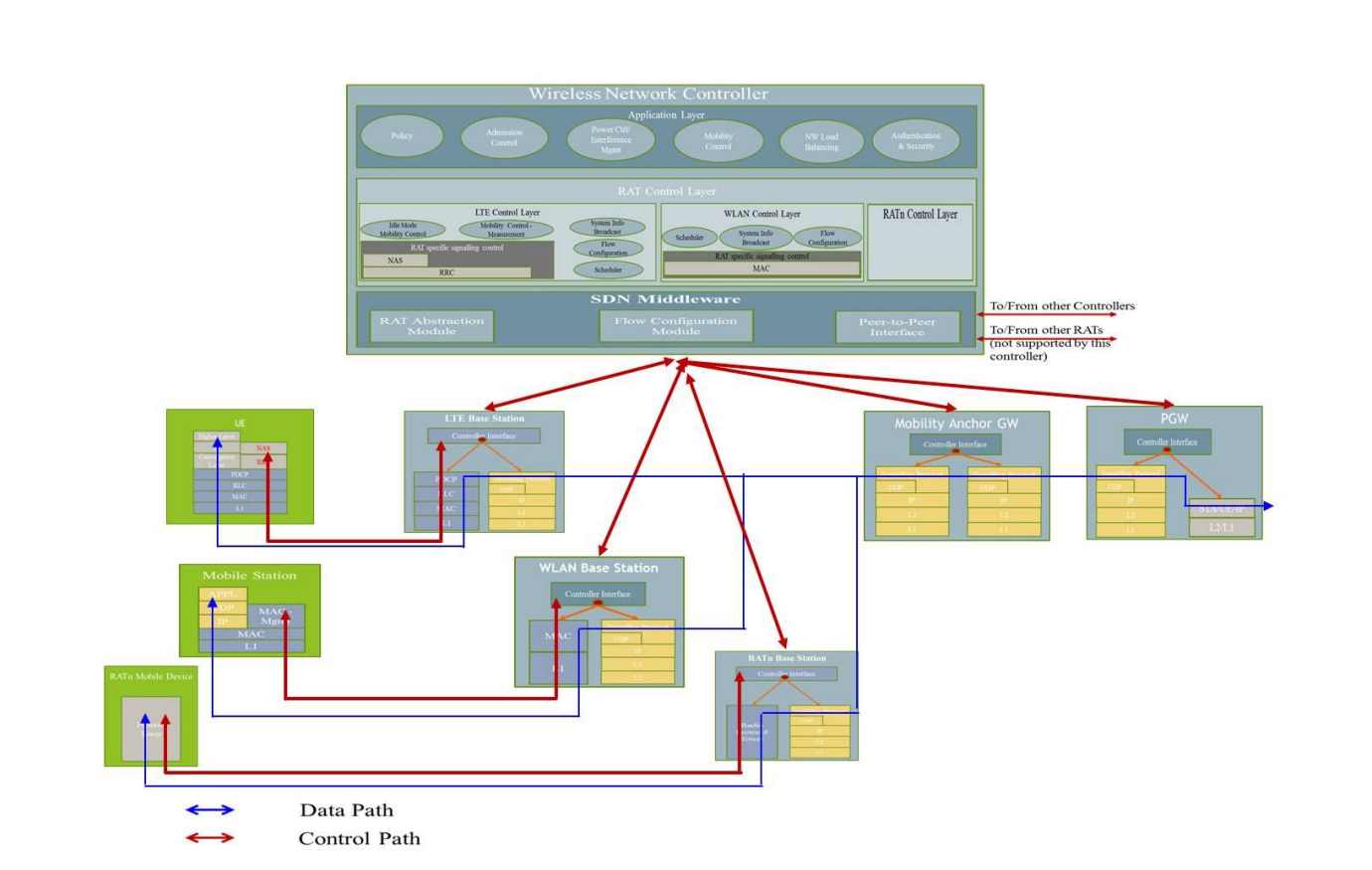
Figure 1. Network architecture
Current wireless networks operate in silos, with different RATs (like LTE, Wi-Fi) managed separately. This results in complex architectures, redundant equipment, and inefficient use of network resources. Furthermore, interoperability between these RATs is difficult, leading to poor handover performance and high operational costs. There is a lack of centralized control to manage mobility, load, and quality of service across heterogeneous networks.
- Centralized WNC: The technology introduces a WNC that handles all control-plane operations such as flow configuration, signaling, and resource management, enabling simplified and unified control across RATs.
- Seamless Multi-RAT Integration: It supports communication across LTE, WLAN, and future technologies using the same system, without requiring protocol changes in user equipment (UE).
- Efficient Handover Management: It implements intra-LTE and WLAN-to-LTE handover processes that maintain session continuity and data integrity through coordinated control by the WNC.
- Load Balancing and Interference Control: It performs real-time traffic distribution and adjusts transmit power dynamically to manage interference and enhance network coverage.
- QoS and Policy Management: It configures and schedules traffic flows to meet service-specific Quality of Service (QoS) parameters, optimizing for both real-time and data-intensive applications.
- Secure and Adaptive Communication: It includes authentication, encryption, and subscriber validation mechanisms integrated into the WNC, ensuring secure and controlled access.
The prototype includes a WNC that centrally manages control-plane operations for LTE and WLAN base stations. It interacts with standard user devices (no modifications needed) and supports procedures like handovers, flow management, and load balancing. The system can be deployed using cloud infrastructure and uses existing RAT-compatible hardware, showcasing practical feasibility for real-world network environments.
The patent includes complete specification, a detailed claim set, and supporting figures. The patent is suitable for immediate prototyping and development for existing network systems.
2
This system modernizes the wireless communication landscape by unifying different technologies under one framework, drastically improving accessibility, reliability, and manageability of networks. It ensures better connectivity in both urban and rural settings, promotes efficient resource usage, and supports critical services such as emergency communication, remote learning, and telemedicine without requiring device upgrades for end users.
- Telecommunication Operators like streamlines infrastructure and enhances multi-network performance
- Smart Cities which support unified communication frameworks for IoT and citizen services
- Public Safety Networks that ensure secure and continuous connectivity during handovers
- Enterprise Networks that enable large organizations to manage multi-technology communication environments efficiently
- Defense and Government Agencies which provide centralized control and secure communication across diverse devices and terrains
Geography of IP
Type of IP
201721008015
447976