
This invention presents a Software Defined Networking (SDN)-based system to improve wireless communication by managing an overlay network on top of existing multi-RAT (Radio Access Technology) infrastructure. The system uses SDN controllers to dynamically assign relay nodes among user devices, optimize communication paths, enhance secure communication, and manage energy and interference in real-time. The method offers improved network performance, coverage, and efficiency, especially in areas with weak cellular connectivity.
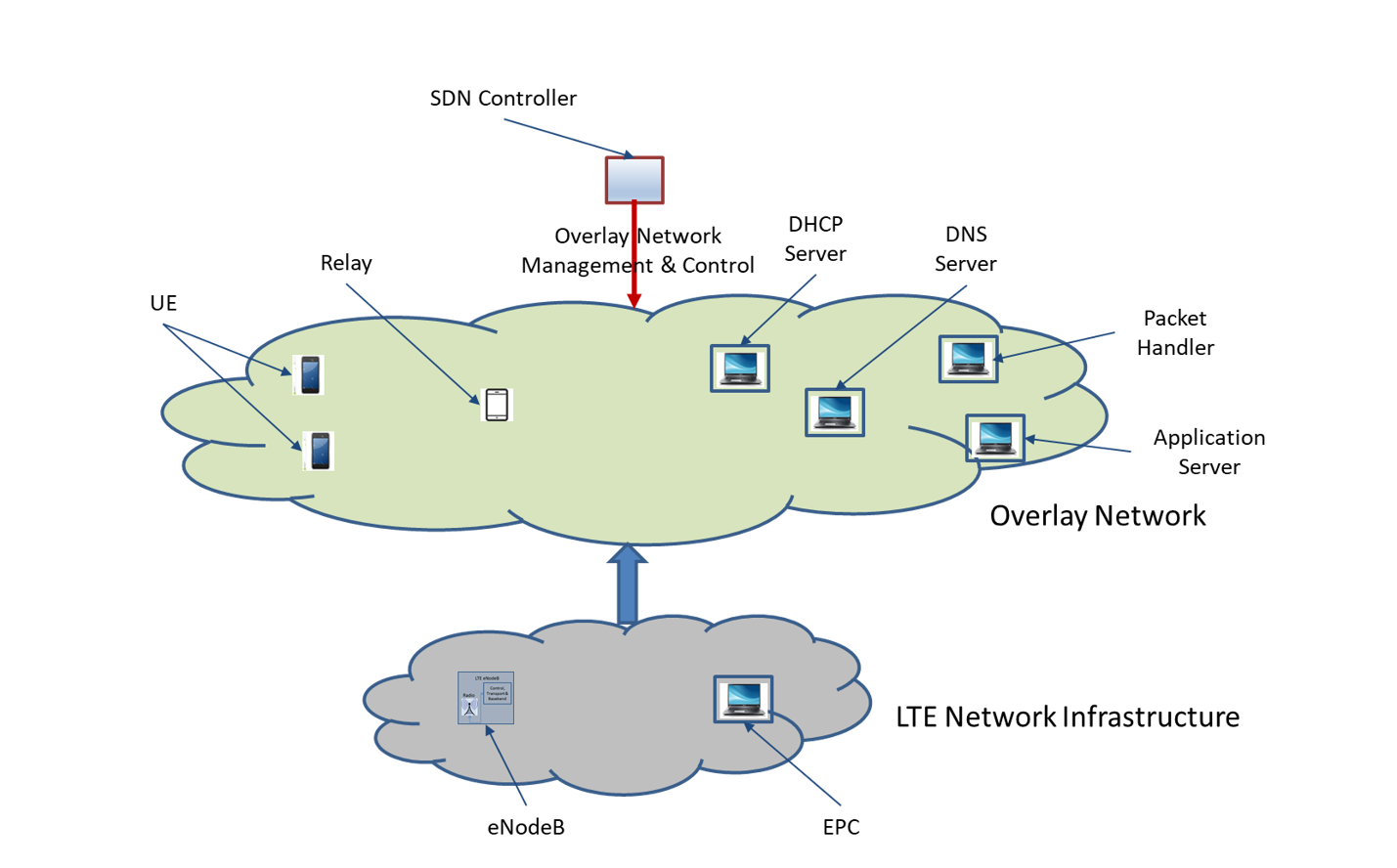
Figure 1. Concept illustration
Traditional cellular networks struggle with poor coverage in obstructed areas like inside buildings, and current D2D (Device-to-Device) or relay-based solutions face technical and security challenges. Existing relay models require complex hardware and are inefficient in multi-hop communication, often resulting in high battery drain and interference. There is no centralized mechanism to select optimal relays or ensure secure, energy-efficient communication paths, making current methods inadequate for mission-critical services.
- SDN-Controlled Relay Designation: The SDN controller assigns optimal relay nodes based on device location, battery, SINR, and data capacity, ensuring efficient routing.
- Overlay Network Architecture: An overlay network is formed over a primary wireless network using supplementary radio links (e.g., Wi-Fi, Bluetooth) to improve coverage and resilience.
- Secure Device Communication: The system authenticates all devices via HSS/AAA and supports encrypted communication over supplementary channels, enabling use in public safety applications.
- Load Balancing and QoS Management: Load is distributed based on data capability and network quality to support high-priority or mission-critical data like voice/video.
- Battery-Aware Relay Switching: Relays are dynamically reassigned when battery thresholds are reached, preserving device power while maintaining network continuity.
- Multi-Hop and Interference Management: It supports multi-hop relay with interference reduction by channel allocation and power adjustments, increasing network throughput.
The prototype consists of a software-defined overlay network built over existing wireless infrastructure (like LTE), using standard mobile devices equipped with supplementary interfaces (Wi-Fi/Bluetooth). An SDN controller dynamically assigns relay roles to devices based on battery, location, and signal quality. Devices act as relays and user equipment (UEs), forming a multi-hop wireless network managed centrally for efficient and secure data transfer.
The patent includes complete specification, a detailed claim set, and supporting figures. The patent is suitable for immediate prototyping and development for existing network systems.
2
The solution enhances connectivity in under-served or obstructed areas (e.g., indoors, rural zones) and is especially useful in emergency communication scenarios. By enabling energy-efficient and secure relay-based communication, it supports public safety networks and critical communication services like disaster response, telemedicine, and smart city infrastructure.
- Mission-critical services like Push-to-Talk (MCPTT), emergency alerts, and disaster communications
- IoT data routing in dense urban or infrastructure-heavy areas
- Telecommunication Providers for enhancing indoor coverage and traffic offloading
- Defense & Military Communication Secure and reliable communication in field conditions
- Mobile fleet connectivity in low-signal areas
Geography of IP
Type of IP
201821004104
443887