
By disrupting transport of fat inside liver cells, IIT Bombay researchers have opened a new path to tackling high cholesterol and other fat-related disorders.
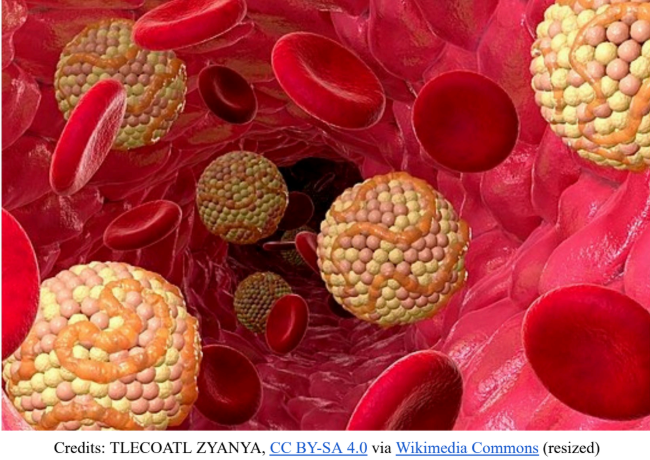
The human liver is like the body's fat traffic controller, deciding how much fat to store and how much to release, depending on the body’s needs. Tucked inside the liver cells, there are microscopic compartments called lipid droplets—temporary reservoirs for fats such as triglycerides and cholesterol. The liver packages some of these fats into tiny particles called very low-density lipoproteins (VLDL) and releases them into the bloodstream. But push this system too hard with a consistently high-fat diet, and then this natural process is disturbed and causes a dangerous build-up of lipids, paving the way for obesity, diabetes, and heart disease.
Now, researchers at the Indian Institute of Technology (IIT) Bombay, along with collaborators from the Indian Institute of Science Education and Research (IISER) Pune, and IISER Kolkata, have uncovered one of the key cellular mechanisms that can interrupt this VLDL release from the liver by targeting the physical movement of lipid droplets instead of enzymes, receptors, or genes that are traditionally used for lowering lipids in the bloodstream. Importantly, interrupting this cellular mechanism does not cause lipid buildup in the liver—a critical safety advantage for future drug development. The findings open a potential new avenue for treating disorders such as high cholesterol and high triglycerides, as well as conditions like fatty liver disease.
To move around inside a liver cell, lipid droplets rely on proteins called ‘kinesins’ to ferry them to different destinations within the cell. Prof. Roop Mallik's laboratory at the Department of Biosciences and Bioengineering, IIT Bombay, has been investigating this lipid-transport process for more than a decade. “Earlier work from our group showed that the motor protein kinesin-1 specifically drives lipid droplets toward the edge of the cell where VLDLs are assembled and released in the bloodstream,” explains Prof. Mallik, who led the research. This raised a compelling question: could disrupting this transport reduce the amount of fat exported from the liver?
Complete blocking of kinesin-1 disrupts other essential cellular processes dependent on kinesin and destabilises the cell itself. Therefore, “Our goal was to selectively inhibit only the lipid droplet interaction (with kinesin) and to regulate how excess lipids are transported and released into the bloodstream,” says co-first author Dr. Subham Kumar Tripathy.
The breakthrough came when Prof. Mallik's team discovered earlier that the tail region (amino acids present at the end region of a protein sequence) of the kinesin-1 protein disrupted the positioning of lipid droplets in liver cells without affecting other cell organelles. This difference is rooted in the structural features of the organelles. “Most membranes inside cells are made of a double-layer structure called a bilayer. But lipid droplets are unique because they are surrounded by a single-layer membrane, called a monolayer,” explains Dr. Archisman Mahapatra, co-first author of the study.
Building on this foundation, in the current study Prof Mallik’s team identified a short peptide (a short chain of amino acids) called KTDP, derived from the tail region of kinesin-1, to selectively block the protein from attaching to lipid droplets.
Working with Prof. Neelanjana Sengupta’s lab at IISER Kolkata, the researchers used computer simulations and identified that KTDP forms a significantly stronger and more stable bond with the unique monolayer surfaces of lipid droplets than with standard bilayer cell membranes. This difference in binding allows KTDP to physically displace kinesin-1 from the lipid droplet surface and prevent the droplet from being transported to the edge of the cell, where VLDL particles are assembled and released into the blood.
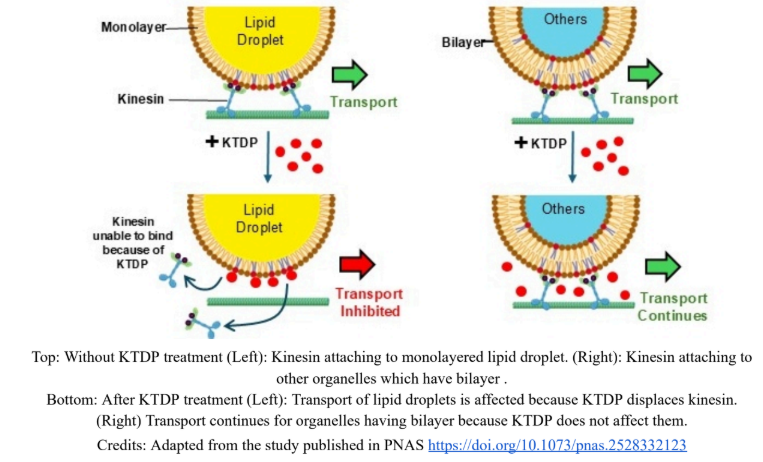
The team then tested the impact of KTDP in cultured rat liver cells, which naturally secrete VLDL particles, making them a useful model for studying fat metabolism. Using biochemical assays and fluorescence imaging experiments, the researchers confirmed that the peptide attaches directly to the monolayer membrane of lipid droplets. “The peptide selectively perturbed lipid-droplet transport while leaving other major intracellular transport largely unaffected,” notes Dr. Tripathy.
With the help of Prof. Siddhesh Kamat's lab at IISER Pune, the researchers measured the amount of fat the rat cells released after lipid-droplet transport was inhibited. Using lipidomics and biochemical tests, the researchers found that triglyceride and cholesterol secretion dropped by roughly 50% after KTDP was added to the cells.
A key concern at this stage for researchers was whether blocking fat export from the liver might cause dangerous lipid buildup inside the liver, potentially encouraging fatty liver disease. Surprisingly, this did not happen. Instead, live imaging experiments from Prof. Mallik’s group showed that fatty acids were being rerouted from lipid droplets to mitochondria— the cell's energy-generating organelles, where they were broken down for energy.
Given the promising findings in cultured rat cells, the team wanted to test whether KTDP could deliver similar results in a living vertebrate. Collaborating with Prof. Sreelaja Nair’s laboratory at IIT Bombay, they utilised zebrafish as a model organism owing to their human-like lipoprotein systems. The zebrafish were initially fed a high-fat diet and later fed KTDP via fluorescently coated egg-yolk liposomes— tiny fat-like droplets capable of carrying biological molecules into the body.
“Using egg liposomes specifically to deliver a therapeutic peptide to the liver is something we developed in this study,” says Dr. Mahapatra. Since zebrafish larvae are almost transparent, the researchers could directly visualise these lipids under the microscope without harming the animals.
Under the microscope, fluorescence imaging confirmed that the peptide reached the liver. The researchers found that triglyceride and cholesterol levels in the blood had decreased by roughly 50% after KTDP treatment in both larvae and adult fish, consistent with observations in rat cells.
Highlighting the importance of their work, Prof Nair says, “A novel breakthrough lies in loading a small peptide into liposomes made from eggs to successfully lower lipid levels in zebrafish blood. To our knowledge, this has never been done before.” The researchers have filed a patent related to this egg liposome-based delivery approach.
The effectiveness and safety of the researchers’ approach was confirmed as the zebrafish showed no developmental abnormalities, increased mortality, or harmful lipid accumulation in the liver after KTDP treatment over several days of monitoring.
The work is at a preclinical stage, requiring future studies to assess long-term safety, optimise peptide delivery, and evaluate efficacy in mammals. Nevertheless, the study points toward a promising direction that has so far received little attention in the treatment of metabolic diseases.
“Current therapies are effective at lowering cholesterol, but options for reducing triglycerides remain limited,” says Prof. Mallik. “We believe this work could eventually contribute to new strategies for addressing that challenge.”
For Prof. Mallik, the study is the culmination of a long journey. “What began as a fundamental curiosity-driven question about intracellular transport gradually revealed a potentially important therapeutic opportunity for metabolic disorders,” he concludes.
Prof. Roop Mallik, Department of Biosciences and Bioengineering, Indian Institute of Technology Bombay