
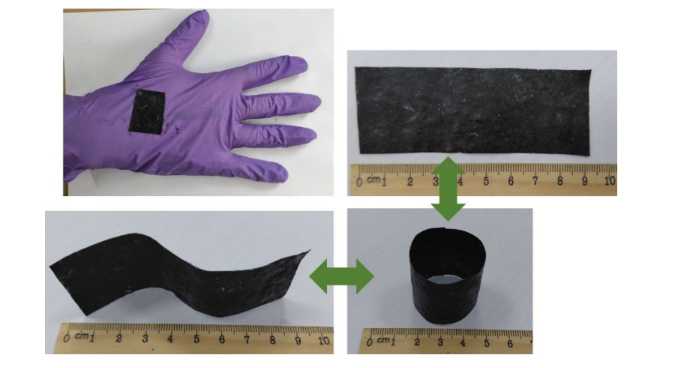
Warm clothing, like a sweater, protects us in cold climates by trapping the natural body-heat and thereby minimizes its loss to the cold environment outside. Turns out that there might be another smarter and sustainable way to keep ourselves warm during cold nights. Researchers at the Indian Institute of Technology Bombay, jointly with IISER Trivandrum, have developed a wearable, lightweight, fabric patch that directly absorbs sunlight, stores it internally as heat and releases the heat in dark. All this is done without any wires, electricity or any bulky components.
Thermal battery for decarbonization
Thermal battery works by storing of heat energy. It releases the heat during discharge and acts without any wires or electrodes, unlike a conventional battery where chemical energy is converted to electrical energy and vice-versa. Thus, thermal batteries can potentially provide better efficiencies and offers robust, reversible operation over multiple cycles. Importantly, they are easier to manufacture, maintain and use.
More than 60% of global energy use is thermal, and much of it still comes from burning fossil fuels—for space heating, industrial processes, and personal comfort. Decarbonizing heat is therefore essential for climate action. While solar energy is abundant, storing it reliably—especially as heat—remains a major challenge.
Polymer for trapping storing sunlight as heat
In the current work, the scientists stitched together alternate chains of polyethylene glycol (PEG) and polystyrene co-allyl alcohol (PSAA). While PEG is a thermally soft, flexible polymer and is known for its high heat-storage capacity, PSAA is a rigid polymer that provided structural cohesivity and stability. When combined into a single polymer with alternating PEG and PSAA units, the PEG chains becoming fluid when heated, while the polymer still behaved like a solid. As the temperature rises, segments of the polymer chains transition from an ordered (crystalline) arrangement to a disordered (amorphous) one. This structural reorganization absorbs heat, much like melting does—but without any liquid phase.
This selective ‘melting’ of PEG chains gives rise to all-solid phase change from crystalline state (below 21°C) to amorphous state (above 50.2°C). Finally, the addition of graphene oxide in the matrix introduced a second crucial function: direct solar-to-heat conversion. “This gave us a multifunctional material that can capture sunlight, convert it into heat, spread that heat efficiently, and store it reversibly—all within a single solid composite without any wires or electrodes” says Prof. C. Subramaniam.
This study is led by Mr. Goutam Nayak, Prof. Sandip Saha and Prof. Chandramouli Subramaniam from IIT Bombay, in collaboration with Prof. Vinesh Vijayan from IISER Trivandrum and has been published in Small (View here: hƩps://onlinelibrary.wiley.com/doi/10.1002/smll.202510783). The NMR study carried out Prof. Vinesh Vijayan provides clear evidence on how the PEG segments move at different temperatures. Below about 15 °C, the chains are constrained and rigid; above this threshold, they gain mobility, enabling efficient heat storage. This molecular-level understanding explains how the material achieves both high energy density and excellent reversibility.
A Thermal Battery That Beats Benchmarks
When tested as a solar-thermal battery, the material heats rapidly under sunlight, reaching operating temperatures of 69°C within minutes. During this process, a clear temperature plateau appears—direct evidence that heat is being stored through a phase change rather than simply warming the material. Subsequently, taking it to dark conditions reverses this entire process, resulting in release of the stored heat energy. The thermal battery exhibits and energy density of ~50 Wh/kg and power density of ~129 W/kg, with heat-storage efficiency of ~ 97%. Importantly, the engineered phase-transition enables robust and stable performance over 300 charge–discharge cycles.
These values surpass targets set by the U.S. Department of Energy for phase-change thermal storage materials, a rare achievement for polymer-based systems.
From Lab to Wearable Comfort
Perhaps the most striking demonstration comes from a wearable prototype. The polymer composite was coated directly onto cotton fabric and integrated into a glove. “Since all the individual components are bio- compatible, the polymer composite is safe to contact with human skin or clothing” stresses Prof. Sandip Saha. Under sunlight, the patch heats rapidly, while the wearer’s hand remains at a comfortable temperature. When the light is turned off, the stored heat is released gradually, providing sustained warmth in the dark. The material is also flexible, lightweight, and entirely solid, it can be seamlessly integrated into textiles without compromising comfort or mobility. This opens the door to personalized thermal management—wearable systems that warm people rather than entire rooms, dramatically reducing energy consumption.
In a world striving to decarbonize energy use, sometimes the most transformative solutions begin not with electricity, but with rethinking how we store heat itself.
Link to the published article : https://onlinelibrary.wiley.com/doi/10.1002/smll.202510783
Correspondences : csubramaniam@iitb.ac.in