
Researchers at the Indian Institute of Technology Bombay have developed a host of novel, eco-friendly materials by combining everyday plastics with strong and biodegradable materials, like wild grasses.
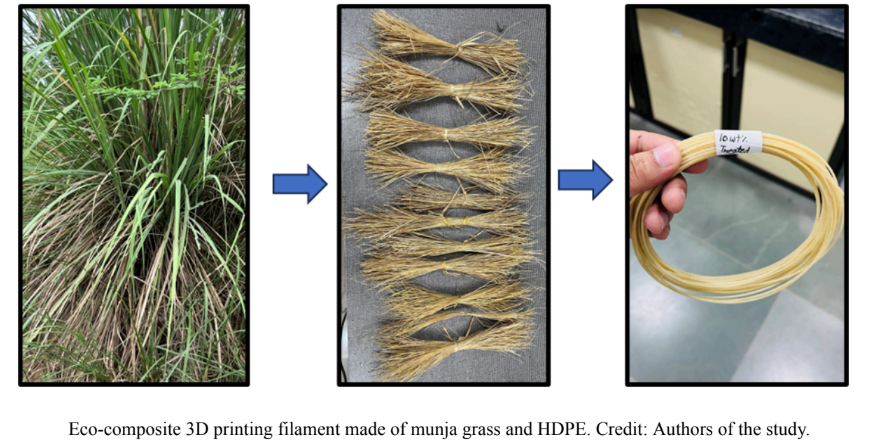
Synthetic plastics have been the undisputed leader of global manufacturing in the modern era. From packaging to car parts, their durability and low cost have made them indispensable. However, they take centuries to degrade, accumulate in landfills or oceans, and devastate ecosystems. Synthetic fibre-reinforced plastics, like fibreglass or carbon fibre, are notoriously difficult to recycle and rely heavily on depleting, non-renewable fossil fuels. The urgent need for sustainable alternatives has led scientists and engineers to the forefront of biodegradable natural-fibre composites. By mixing agricultural waste, fast-growing native grasses, and recycled polymers, researchers are creating materials that enhance the mechanical strength of traditional plastics but with a fraction of their environmental footprint.
“It increases the extent of the biodegradable component in the matrix. These fibres are also cheaper than thermoplastics. The strength and toughness of the composites improve significantly by adding these natural fibres,” explains Aparna Singh, a professor at the Institute of Technology (IIT) Bombay, about the need for these natural-fibre composites.
Prof. Singh and her student Nitin Kumar Arya, along with their team at IIT Bombay, are steering the development of sustainable composite materials, and some of their recent patents showcase just how far this technology has come. They have developed a host of novel, eco-friendly materials by combining everyday plastics with biodegradable materials, such as Munja and Bermuda grass. These green composites are stronger, tougher, lightweight, cost-effective, and highly recyclable, marking a pivotal shift toward a circular economy.
“While many studies focus on commercial natural fibres such as hemp, flax, or jute, our work demonstrates the engineering potential of abundant indigenous grasses which remain largely unexplored for advanced polymer composite applications,” explains Prof Singh.
Innovations in the eco-composite space often relied on complex, expensive recipes. They also relied heavily on chemical compatibilisers (chemical additives used to mix immiscible polymers), dispersion agents, and synthetic binders just to make the natural fibres stick to the plastic. Prof Singh’s work does away with much of this toxic complexity. Her team has been developing eco-friendly methods for combining plastics with fibre, resulting in several patents. Their work utilises abundant, native grasses, specifically Saccharum munja (munja grass) and Cynodon dactylon (Bermuda grass), to reinforce epoxy resins, recyclable high-density polyethylene (HDPE), polypropylene (PP), and biodegradable polymers such as polylactic acid (PLA), effectively outperforming conventional materials.
Prof. Singh’s team developed a method to mix finely chopped Saccharum munja fibres directly with HDPE pellets, without relying on any chemical blending agents. The components of the composite are pushed through an injection moulding machine to create highly durable, eco-friendly parts that are significantly cheaper and lighter than traditional glass-fibre composites.
Another interesting invention utilises Bermuda grass. While it is usually considered a fast-growing weed, its dense, fibrous nature makes it an excellent reinforcement agent. By treating Bermuda grass with a simple alkaline (sodium hydroxide) solution to strip away natural waxes and impurities, the fibres bond tightly to HDPE. The resulting material boasts a tensile strength that far exceeds that of pristine HDPE.
“Natural fibres inherently possess hydrophilic surfaces, whereas HDPE is hydrophobic. This mismatch generally leads to poor fibre–matrix adhesion, inefficient stress transfer, and deterioration of mechanical properties. Achieving strong interfacial bonding without relying heavily on expensive compatibilisers was a significant challenge,” remarks Prof Singh.
For heavy-duty industrial needs, the researchers have also patented a high-performance Munja fibre-epoxy composite. Moving away from meltable plastics, this invention weaves Munja fibres into fabrics and infuses them with thermosetting epoxy resin using vacuum-assisted moulding techniques. The result is a staggering improvement of about 40% in tensile strength. This means a composite made from wild grass and resin can now legitimately compete with synthetic glass fibre.
In their latest study, the team has tackled another common manufacturing process: 3D printing. 3D printing pure HDPE is notoriously difficult because the plastic shrinks and warps as it cools.
“HDPE is known to be one of the most difficult thermoplastics to process through Fused Deposition Modelling (FDM)-based 3D printing due to its high thermal shrinkage and warpage during cooling. Large dimensional distortions often result in poor layer adhesion and part failure. Overcoming this challenge was one of the primary motivations of the study,” explains Nitin Kumar Arya.
The IIT Bombay team developed a novel 3D printing filament containing 5% to 40% munja grass. “Fibres have a lower thermal expansion coefficient than HDPE,” he adds. This means, unlike plastics, they don’t undergo too much expansion or contraction when heated. When mixed with HDPE, the fibres provide a scaffolding for the plastic, preventing it from warping during printing. By dialling in specific settings for extrusion and build-plate temperatures in the 3D printer, this composite prints flawlessly, enabling rapid prototyping of sustainable, high-strength parts.
The commercial applications for these newly patented materials are vast, spanning across multiple major global industries. As these natural fibre composites are incredibly lightweight yet highly rigid, they can be used in the automotive industry for fuel tanks, vehicle interior panels, dashboards and bumpers. Due to increasingly strict regulations on vehicle end-of-life and recycling in India, plastics must either be efficiently recyclable or manufactured using sustainable materials with a high content of natural fibres. At home, they are ideal for eco-friendly building panels, structural supports, temporary construction boarding, and high-quality furniture like chairs and tabletops, all without the threat of termite damage or moisture rot. For consumer goods and packaging, it can help replace single-use or hard-to-recycle plastics. These composites can be moulded into durable household items, reusable tableware, and green packaging solutions.
“The research successfully demonstrated the use of the same natural fibre system in injection moulding, fused deposition modelling (3D printing), and vacuum-assisted resin transfer moulding (VARTM). This broad processing compatibility significantly enhances the industrial scalability and commercialisation potential of the developed composites,” says Nitin.
As the world urgently searches for ways to cut carbon emissions and reduce reliance on synthetic, non-recyclable materials such as carbon or glass fibres, green manufacturing is becoming essential. By turning a common, fast-growing wild grass into a strengthening agent for recyclable plastics, scientists are paving the way for cheaper, environmentally friendly manufacturing. From lightweight automotive parts to sustainable product packaging, this grass-reinforced plastic brings us one step closer to a future of truly sustainable manufacturing.
Prof. Aparna Singh:, Department of Metallurgical Engineering and Materials Science, Indian Institute of Technology Bombay