
By combining cobalt, nickel, and graphite, using molecular precursor engineering, researchers have engineered a low-cost, highly durable catalyst that efficiently splits water into hydrogen and oxygen, paving the way for affordable green hydrogen energy.
Recently, India inaugurated the world’s first nuclear-powered hydrogen production plant at the Indira Gandhi Centre for Atomic Research in Kalpakkam, Tamil Nadu. Unlike others, which rely on electricity, the new plant uses nuclear-generated heat to produce hydrogen. Hydrogen offers a clean-burning fuel that could replace fossil fuels. It boasts a high energy density, nearly three times that of petrol, and emits only water vapour. Hydrogen, however, doesn't occur freely in nature and must be extracted from sources, like water. Scientists across the globe have been looking for ways to efficiently split the water molecule and extract hydrogen.
In a breakthrough, researchers at the Indian Institute of Technology (IIT) Bombay have developed a highly efficient, low-cost catalyst that could significantly improve the production of green hydrogen. The team created a novel material combining cobalt, nickel, phosphate, and graphite that efficiently produces hydrogen and oxygen gas from water.
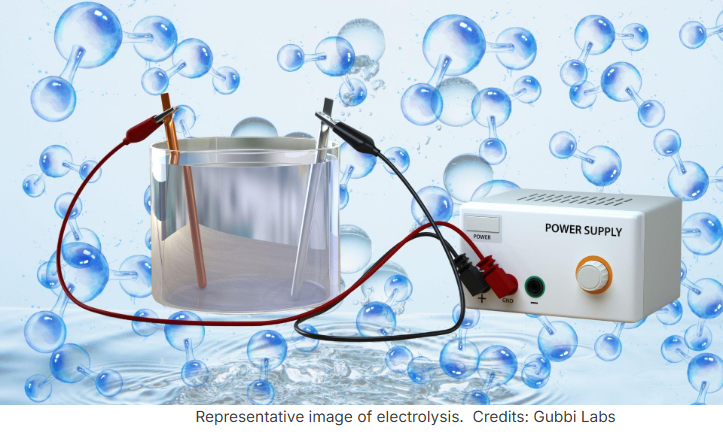
One of the simplest ways to split the water molecule is by electrolysis, in which an electrical current is passed through water to separate it into hydrogen and oxygen. The current induces two reactions: a hydrogen evolution reaction (HER) at the cathode, which generates hydrogen gas, and an oxygen evolution reaction (OER) at the anode, which generates oxygen gas. This process, however, faces significant kinetic barriers, requiring substantial energy to get started.
The energy barrier can be reduced by using catalysts, which accelerate the reactions without being consumed.
Currently, the gold standard for these reactions relies on precious metals like platinum, ruthenium, and iridium. While highly effective, these noble metals are scarce, incredibly expensive, and prone to degradation over time under harsh operating conditions.
“The primary motivation was to develop an efficient and durable earth-abundant catalyst for overall water splitting,” explains Dr Savi Chaudhary, a researcher at IIT Bombay and the first author of the study.
To fabricate the new catalyst, the researchers turned to molecular precursor engineering, a technique that involves designing highly specific molecules and metallic compounds that serve as building blocks or precursors for more complex materials.
According to Dr Chaudhary, “the molecular precursor approach is advantageous because it allows precise control over the composition and homogeneity of the resulting material, while enabling its conversion into the active catalyst under relatively mild conditions.”
They first created distinct metal complexes of cobalt and nickel phosphates. Then, they mixed these complexes with atomically thin layers of carbon called exfoliated graphite and gently heated the mixture. As the heat broke down the carbon parts of the metal complexes, it left behind a perfectly mixed, amorphous layer of cobalt-nickel phosphate evenly spread across the conductive graphite sheets. The final result was a bifunctional catalyst that simultaneously performs both halves of the water-splitting reaction.
“The combination of cobalt and nickel provides bifunctional activity toward both HER and OER, while the conductive graphite support enhances charge transport and promotes efficient utilisation of the active material,” remarks Prof. Ramaswamy Murugavel, professor at IIT Bombay and the corresponding author of the study.
The amorphous nature of this material means its atoms are arranged randomly instead of being neatly arranged as in a crystal. This also enhances its performance, as its disordered structure creates a larger surface area that serves as ideal docking sites for both HER and OER.
“We initially anticipated that the complexes would generate crystalline phosphate materials. Instead, an amorphous Co-Ni phosphate phase was formed with excellent homogeneity. Interestingly, the combination of the amorphous mixed-metal phosphate and exfoliated graphite resulted in significantly enhanced electrocatalytic activity,” remarks Dr Chaudhary.
During testing, the new catalyst ran continuously for 72 hours with almost no drop in performance. The researchers, however, observed that the catalyst's surface underwent a structural transformation during the oxygen-producing reaction, shedding some phosphate to form new oxygen-rich metal compounds. However, rather than degrading the catalyst, this surface reconstruction actually helped maintain its high activity.
“The surface reconstruction highlighted an important feature of phosphate-based catalysts: under catalytic conditions, the surface reconstructs into more active oxyhydroxide species while the underlying phosphate framework helps maintain chemical stability and structural integrity,” says Prof Murugavel.
The development of this robust, earth-abundant catalyst could help power a sustainable energy future. By eliminating the reliance on expensive noble metals and proving that affordable, highly active materials can be engineered in the lab, the research brings the world one step closer to producing cheap, zero-emission hydrogen fuel for powering our homes, vehicles, and industries. More importantly, the team believes that the process used to fabricate the catalysts could represent an important advancement in producing more precise materials.
“We believe the most important message of this work is that molecular precursor engineering offers a powerful and versatile route for designing advanced electrocatalysts,” concludes Dr Chaudhary.
Prof. Ramaswamy Murugavel, Department of Chemistry, IIT Bombay