
Researchers have developed advanced mathematical models and hybrid machine learning tools that accurately predict how 3D-printed ceramic and metal parts shrink and warp during high-temperature heat treatment.
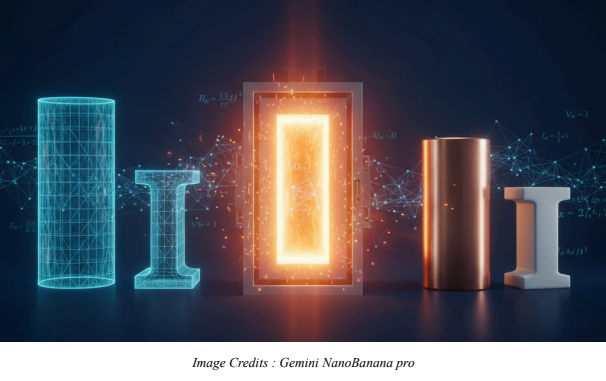
What has a dental implant for your damaged tooth got to do with high-temperature kilns? Chances are that the implant is made using a 3D printing process—technically called additive manufacturing—that needs sintering at its final stage. Sintering is the process of heating in a kiln to a high temperature. Resilient materials needed to mimic the durability and appearance of natural teeth are difficult to shape using traditional methods. Even the usual additive manufacturing methods, in which a laser fuses the material while it is deposited, are difficult to use for such materials. Hence, fine particles of the implant material, mixed with a binding agent, are layered to construct the implant, and then sintered to burn away the binder, fusing the particles into a solid structure.
Additive manufacturing via laser fusing is also not feasible for high-melting-point ceramic materials, such as zirconia, and for highly reflective materials, such as copper. They need to be printed first and then sintered in an oven. Components shrink by 10% to 15% during sintering. This shrinkage, combined with the tendency of heavy parts to sag under gravity, often leads to final products that do not match their original digital designs in dimensions and shape. While simply upscaling the initial design seems like a logical fix, the material often contracts unevenly. To account for these distortions, manufacturers frequently rely on expensive, time-consuming trial-and-error to achieve a precise fit.
Prof Gurminder Singh and his team from the Department of Mechanical Engineering, Indian Institute of Technology (IIT) Bombay, have developed sophisticated predictive models to predict sintering-induced shrinkage and deformation in components produced using oven-sintered additive manufacturing. Their findings, published across two studies focusing on ceramics and copper, demonstrate that it is possible to precisely calculate at the design stage how a part will change shape during sintering. This information can help determine appropriate dimensions for 3D-printed parts at the design stage.
In the study on ceramics, the researchers Pranith Kumar Reddy Puchakayla, Prof Prasanna Gandhi and Prof Gurminder Singh used 3 mol% yttria-stabilised zirconia (3-YSZ). They used a physics-driven modelling approach to create a constitutive model—a set of mathematical equations—that describes the material's behaviour as a viscous fluid during heating. They found that by measuring how the material’s density and viscosity change with temperature, they could predict the final dimensions of complex shapes, such as cylinders and "pine tree" structures, with high accuracy.
“Viscosity governs the behaviour during printing and indicates how easily the material flows, how well the layers stack, and how much internal stress is stored in the printed part. Relative density (ratio of the density of the printed part to the theoretical density of the material), on the other hand, governs behaviour before sintering and indicates how much solid material is present and how much pore volume exists. Lower density before sintering means higher shrinkage and deformation,” explains Prof Gurminder Singh. Measuring viscosity tells us why and how the part can deform during printing, while measuring relative density tells us how much it will deform.
A 3D-printed part becomes denser when sintered. To analyse densification, they incrementally increased the heat, maintaining specific temperature intervals to observe how density and shrinkage affect densification speed. In a second experiment, the researchers applied a fixed weight load at each temperature step and estimated the viscosity at the corresponding level of densification. To estimate viscosity at different stages of densification at the same temperature, the researchers maintained the temperature step for a longer period. They applied incremental weight load at each temperature step.
“The weight load is applied to simulate real mechanical loading conditions. Without the weight, only pure thermal shrinkage is observed. With the weight, thermo-mechanical deformation is captured, which is much closer to the behaviour of real industrial parts. The weight-based study enables the investigation of structural stability during sintering,” says Prof Gurminder Singh. The researchers built this data into a simulation. They validated it using three increasingly complex shapes: a cylinder, an I-section, and a "pine tree" structure with multiple overhanging branches.
The team reported that the model was highly effective, predicting final dimensions with an error of only 0.8% to 2.03%. A key finding was that the specific mix of ceramic-particle sizes in the ceramic slurry made the parts highly resistant to "creeping" (slowly bending under their own weight), allowing even long overhanging branches to remain straight during sintering. The simulation also accurately mapped internal stresses, confirming that the parts would not crack or fail during the process.
In a second study focused on copper, Sri Bharani Ghantasala and Prof Gurminder Singh developed a hybrid model that combined traditional physics-based simulations with Artificial Intelligence and Machine Learning. The team conducted eight sintering experiments by varying seven input parameters, including the sintering temperature, the time the temperature is held, the rate at which the temperature is attained, the rate of cooling, the total process time, and the initial relative density of the sample. By training an Artificial Neural Network (ANN) on a massive dataset including real experimental data and computer-generated results, they taught the system to predict how the material's density changes during the heating cycle.
The researchers used SHAP (SHapley Additive exPlanations). This method quantifies the contribution of each input parameter to a machine learning model's final prediction, revealing which process parameters dominate deformation and whether each parameter increases or decreases it. They found that process time and heating rates are the most influential factors in determining how a part eventually settles into its final form. They tested this AI-driven model on complex shapes, such as I-sections, to see whether it could predict how gravity causes overhanging features to sag.
The hybrid model matched experimental results with a 98% success rate. It significantly outperformed traditional computer models in predicting the final shape of sagging overhanging parts.
Together, the studies show that shrinkage and deformation in additive manufacturing, followed by sintering, are predictable and not random. “This shifts the field from trial-and-error sintering toward predictive, model-based manufacturing, which represents a major paradigm change in advanced additive manufacturing science. This type of framework can eventually lead to smart CAD tools where predicted shrinkage fields are automatically applied to the design, pre-compensated geometries are generated directly,” concludes Prof Gurminder Singh.
Prof. Gurminder Singh, Department of Mechanical Engineering, IIT Bombay