
A DNA-based strategy from researchers of Indian Institute of Technology Bombay makes drug-resistant bacteria responsive to antibiotics again.
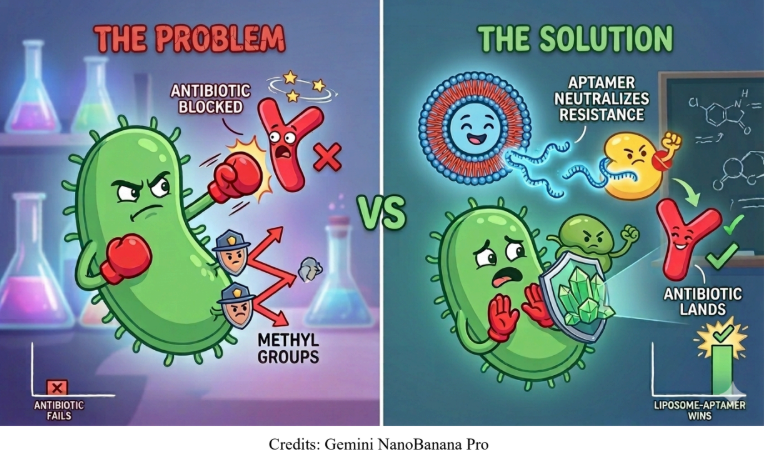
Antibiotics are routinely used to treat illnesses ranging from pneumonia and tuberculosis to urinary tract and bloodstream infections, and to prevent infections during surgeries, organ transplants, and chemotherapy. Yet their widespread and often indiscriminate use has fuelled a quieter crisis: antimicrobial resistance. According to a WHO report, in 2023 alone, one in six clinical laboratories confirmed that bacterial infections worldwide were resistant to antibiotic treatments.
Bacteria are evolving diverse ways to neutralise our most reliable drugs. Between 2017 and 2022, only about a dozen new antibiotics have reached the market, and most are derivatives of existing classes, leaving them vulnerable to resistance mechanisms that bacteria have already evolved. Even when new drugs are introduced, microbes continue to adapt, and resistance can emerge quickly. This reality has pushed scientists to rethink not only how antibiotics kill microbes, but how to stop bacteria from disarming them in the first place.
Two recent studies from the Indian Institute of Technology Bombay, led by Prof. Ruchi Anand and Prof. P. I. Pradeepkumar, from the Department of Chemistry, presented a different strategy. Instead of developing yet another antibiotic, the team focused on protecting the ones that already exist. Their work, published across two complementary papers, uses short DNA sequences that can bind to and block the enzymes that bacteria use to resist antibiotics. By stopping these enzymes from working, the researchers were able to make resistant bacteria respond once again to common antibiotics.
“Given the long, expensive path from drug discovery to clinic, improving existing drugs may be a more practical route. We know its safety and effects over the years and can use existing resources,” says Prof. Ruchi.
Several important antibiotics, including erythromycin and related drugs, work by attaching to the bacterial ribosome. The ribosome is a molecular machine that builds proteins. When these antibiotics bind to the bacteria’s ribosome, protein production stops, and the bacteria die.
However, many bacterial enzymes called erythromycin resistance methyltransferases (Erm proteins), add a small chemical group (methyl group), to a specific spot on ribosomal RNA—a process known as methylation. By methylating the ribosomal RNA, these enzymes subtly alter the antibiotic’s binding site. As a result, the drugs can no longer bind properly, protein production continues, and the bacteria survive.
In the first study, the researchers, Leena Badgujar, Damini Sahu, Prof. Ruchi and Prof. Pradeepkumar, focused on specially identified short strands of DNA known as aptamers. Unlike the conventional drugs, aptamers are made up of nucleic acids, synthetically produced, relatively stable, and easier to modify. Thus, they make attractive candidates for therapeutic applications.
To generate DNA aptamers that bind to a specific Erm enzyme known as Erm42, the researchers used a laboratory method called SELEX. This process allows researchers to sift through millions of random DNA sequences and isolate the ones that bind most strongly to a specific target. After multiple rounds of selection and testing with techniques like gel-monitoring assays and surface plasmon resonance, the team identified two aptamers that attached tightly to the enzyme Erm42.
Binding alone is not enough; the DNA must also prevent the enzyme from working.
To test this, the researchers used biochemical assays such as in vitro methylation assays, which measure how efficiently the enzyme performs its chemical task under controlled conditions outside the cell. The results showed that these aptamers prevented the enzyme from transferring methyl groups to ribosomal RNA; thus, inhibiting Erm42 methyltransferase activity.
Further, “we reengineered the DNA aptamers by removing unneeded sequences to enhance their specificity towards the target protein,” says Prof. Pradeepkumar.
While the DNA aptamers worked well in laboratory assays, another challenge remained. It is known that DNA molecules, when administered alone, are vulnerable to nuclease degradation and often struggle to cross bacterial membranes. This makes it difficult for them to enter inside the bacteria.
To address this, in the second study, first author Swagata Patra, along with the researchers of the first study, explored a liposome-based delivery system.
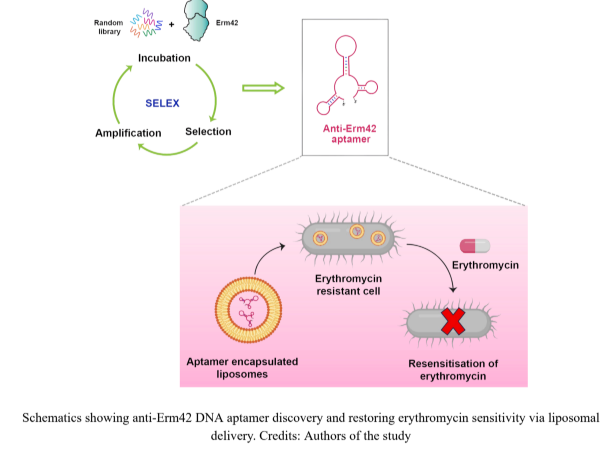
Liposomes are tiny bubble-like spheres made of fatty molecules arranged in a double layer, structurally similar to biological cell membranes. These structures are artificially assembled in the laboratory. In this study, each liposome contained a mixture of three types of lipids: one carried a positive charge to attract the negatively charged DNA, another promoted membrane fusion, and the third improved stability in biological environments. The DNA aptamers were encapsulated inside these lipid spheres.
The resulting particles were about 100-200 nanometres in diameter, a size small enough to be efficiently taken up by cells. They also remained stable in laboratory buffer solution, ensuring that the DNA aptamers remained intact till they reached the target site. The researchers conducted studies that confirmed that the aptamer-loaded liposomes were stable and appropriately sized for biological applications.
The researchers then tested whether these liposomes could deliver aptamers into antibiotic-resistant Staphylococcus aureus, a common cause of difficult-to-treat infections. Once packaged in liposomes, the DNA aptamers' uptake by bacteria increased dramatically, exceeding 90%, compared with virtually no uptake when delivered alone. When tested against resistant bacterial cultures, the liposome-delivered aptamers caused a higher number of bacterial cell deaths than antibiotics alone.
“This is significant because we are inhibiting Erm activity. Methylation of the ribosome is not happening, and the drug can bind back again. The resistance has been reversed,” Prof. Ruchi explains the observations.
Could such an approach scale to clinical use? Prof. Pradeepkumar notes that several factors would need careful evaluation. For example,“the selected aptamers would need to avoid unintended interactions with proteins in the body, and the liposome would have to be safe for human cells.”
Prof. Ruchi is cautiously optimistic. “Synthesising DNA is relatively straightforward, and liposome formulations are already widely used in medicine. Stability can be further improved by chemical modifications at the DNA ends— strategies routinely used in nucleic acid therapeutics.”
In the future, if developed for therapeutic use, the aptamer could be given alongside existing antibiotics. By blocking the resistance mechanism, the engineered aptamer could help restore the antibiotic’s effectiveness.
More work is needed, including animal studies and pharmacokinetic analyses. But “the beauty of the approach lies in the fact that we can resensitise old antibiotics,” concludes Prof. Ruchi.
Funding information:
Scheme for Transformational and Advanced Research in Sciences (STARS) and DBT/Wellcome Trust India Alliance, IIT Bombay-Institute Postdoctoral Fellowship, DST-INSPIRE, and Prime Minister’s Research Fellowship (PMRF).
Please find Media Release and News about "A New Way to Make Old Antibiotics Work Again" Here!!
Prof. P. I. Pradeepkumar, Department of Chemistry, Indian Institute of Technology Bombay
Prof. Ruchi Anand, Department of Chemistry, Indian Institute of Technology Bombay